

Search Chir.ag 'Blog
Search Results
Search text: "support" found in 41 'blog entries.
Good bye FSThu, 10th Aug '23, 10:10 pm::
Twenty one years ago, Eric from Formulated Solutions reached out to me to design a website. First it was just a small Flash-based product brochure, then another with multiple product lines, then his main company site, and then a full e-commerce site with a PayPal shopping cart and customer portal. In 2004, I moved to Florida to work full time at FS, and steadily the company went from just 20-30 employees to 700+ at last count.
With growth, came complexity. At first we made products for tanning salons but soon after we got into personal care products, sunscreens, aerosols, and eventually high-volume brand-name pharmaceutical products. The web apps I built in 2002, running on PHP3, over time got upgraded and extended to run a full ERP system with MRP, planning, inventory, warehousing, quality, and project management modules used by hundreds of employees across multiple sites 24/7.
I made so many friends at Formulated over the years that more than half the contacts in my phone are tagged FS. I am making new friends here in Illinois now but there's no way anyone can take the place of Eric, Brian, Kelly, Linda, David, Sandra, Jeff... I could keep listing names but you get the idea. When I look back, I can only recall the good memories of my years at FS despite the many, many stressful days I know we slogged through.
While I look back at these years with fondness and pride, due to Juliet's ongoing treatments, I have had a very hard time last few years to continue to take care of the FS systems. So this Monday, I said my last good byes and asked the IT team to turn off my access. It was bittersweet for sure. I will miss the camaraderie but I look forward to spending more time with Juliet now. Instead of doing our groceries online, I want to take her to local farmers markets for fresh produce. Instead of fast food, I want to prepare healthier meals with her.
I know not what the future holds but I know my past is full of trust, support, and love during my tenure at FS. I hope to build on that for the rest of my life. And Eric, thanks for taking a chance on me. It was a hell of a ride!
Tech Things I was wrong aboutSun, 29th Nov '20, 11:25 pm::
For centuries, people have made predictions on what the world will be like decades and centuries into the future. I am a lot more interested in 5-10 year predictions than 20-50-100 year ones because the former are more actionable. Like many others, I could easily see that streaming services were going to take over the world and that nearly everyone was going to have a smart phone. Nothing worth bragging about as it was pretty obvious since 2005 unless something went terribly wrong.
What fascinates me are the things that I was wrong about 5-10 years ago, not because I lost money or respect over it (trust me, I care for neither of those) but because it means I was imagining a different world than the one we live in now. It means that today when I see 5-10 years into the future, I could be similarly wrong and it is best that I take some time to look back and alter my underlying assumptions that turned out to be wrong.
1. Bandwidth: I grew up with 28kbps and 56kbps dial-up connection and personally experienced the jumps to DSL, then cable modem, and right into the 2G, 3G, 4G/LTE speeds. And now I manage fiber and cloud networks at 5-10gbps daily. So you would think that someone in my place would be optimistic about there always being enough bandwidth in the future. But turns out I am not. At each of these stages, I could not foresee things getting any faster and instead spent my time optimizing and building for the current speed. While this sounds like a bad thing, it actually works in my favor in day-to-day work situations because it makes me build things that work fast now, not after everyone upgrades to 5G. However, if I was more "futuristic" in my thinking, I would build things for the future. So when 7G comes, my bandwidth-hog 3D video-streaming game-simulation app will be just what people try out first.
2. Video Streaming: Tagging along with my bandwidth shortsightedness, has been my ever pessimistic view on how much video streaming will really be possible. I always thought Netflix wouldn't be able to support streaming a hundred million streams simultaneously so they will come up with alternatives like P2P streaming, DVR-style recording/downloading, custom devices with terabytes of storage etc. But instead they did something that just blew my mind because of how plainly logical it was - they worked with major ISPs and put Netflix servers right on the ISPs internal network and wrote code that cached the most commonly viewed streams. This means that when I click 'Play' on my TV to watch a popular Netflix show, the file is coming to me straight from my ISP's building in my city a few miles away, not across the Internet from New York or California.
3. Compression: I was wrong about how limited the video quality would be too, as I watch nearly everything in 1080p and some 4K today. Compression has continued to blow my mind at how great things look and how small lossy video/audio files are. Sure, nothing beats 70mm film in theory but I can barely see any blurriness or distortion when watching a YouTube video on my phone. Even now I scoff at 8K videos, who needs that! But based on how wrong I have been in the past, within a few years I will surely be annoyed when the 8K stream I'm watching on my virtual glasses hiccups a bit. All of this is made possible due to the insane level of compression thanks to literal geniuses in math, signal processing, and computer science.
4. Battery vs. Phone Weight: I have absolutely been wrong about this and I still don't know why the world doesn't see it my way. My phone is thin and light enough. Even when it's brand new, the battery barely lasts 8 hours. Just make the damn phone thicker and give me a 3-7 day battery! Stop making the screen bigger. But turns out I was wrong. People want thin, light phones that they have to charge 3x a day. Literally every person I know connects their phone to charge the moment they sit down for an hour. I'm not saying I thought batteries would be better by now. I thought people would realize that long battery life was worth the excess weight. But turns out I'm wrong.
5. A.I.: I'm still every pessimistic about strong or general AI i.e. computers with human-level intelligence or beyond (super AI). I don't think that's happening any time soon. I was also always optimistic about weak or narrow AI that has a very specific task like image recognition or text to speech. What I could never imagine was that throwing a data-center's worth of computing resources into a narrow AI can actually make it perform close to a general AI for most purposes. In simpler words, while we don't have a magical smart AI genie, we have really good software that can translate between languages, and if we make that software learn the entirety of everything ever posted on the Internet, the resulting AI will not only be great at translating between languages but it will also be capable of translating between languages it has never seen before. It will also be capable of writing new text in any language, like news reports, based on a few key inputs. This isn't necessary strong AI but for all intents and purposes, it is good enough. If you've read a stock market summary of the day in the last 5 years, it's AI.
6. Bluetooth: I was more optimistic on this than reality turned out to be. I thought we would have better alternatives to crappy Bluetooth by now. Turns out we don't. I don't even want to get into why because it is just 500 pages of depressing.
7. Social Media: I easily saw where Twitter and Facebook were going to end up and the reality is not too far off from my expectations. I am not surprised with walled gardens and information bubbles etc. That was only natural. What I am surprised about is how easily you can still live without them. I don't use LinkedIn, Facebook, Twitter, Instagram, TikTok or any number of cool social media apps. I still read and infrequently post on reddit and watch some of my favorite science/tech channels on YouTube regularly. However, I've easily gone weeks without so much as looking at reddit and I signed up to watch my YouTube creators on Nebula for $5/mo. Literally nothing in my life is going to change if any or all of these social media sites went away instantly today. I might have some more time to kill and maybe will read more. I am utterly shocked that something hasn't compelled me to start using them like kids school programs or neighborhood or medical community chat. As relieved as I am to say all this today, I am also still pretty pessimistic for the future. I'm fairly certain there will be a time when I absolutely will have to sign up for some social media site just to go about my life. Note that I don't hate them or anything. I just don't have the time or energy to maintain an online presence beyond this blog.
8. Remote Desktops: I was more optimistic on this too than what really transpired. I thought by now, we would all have an individual "computer" in the cloud that we'd pay $5-10/mo for and it would have all of our files and software that we could access from any computer, phone, TV etc. I thought may be a small token or app on our phone would make any computer/monitor into a full-blown desktop with all of our data. Technically this is absolutely possible today and it was possible 10-15 years ago too. I just thought it would be common. So if a friend came over, they would just connect to their remote desktop on our living room TV and show vacation photos. Instead, people text each other entire movies (hello #1-3 above) or "cast" their phone to a Android/iOS device connected to the TV. The latter technically mirrors my original vision but the phone is the source of the data, not a gateway to the cloud server, so it's not the same. I think if you are in the Apple ecosystem, there are some signs of going this way with AppleTV playing your iCloud photos/videos, sharing your purchased apps/games with family members etc. However, it's all connecting to computers that Apple controls and manages, not you.
9. Self-driving automobiles: I still can't believe we have these and that they work in most environmental conditions. I also can't believe that they are not already the standard in every new car. I thought it would take forever to have cars that drive on their own. Or rather, the whole world would need to install magnets or sensors underneath every road and highway so trucks and cars would detect them and stay in the proper lane. Instead Narrow A.I. (#5 above) got so good at image recognition and depth perception that it can drive cars and identify road markers in real-time. Totally blows my mind. I also thought that the moment one car company came out with self-driving cars, it would be just a few years before every new car would self-drive because that's the best way to ensure safety and remain competitive. But instead every company is selling a few self-driving features like lane-keep and adaptive cruise control in their higher-end models while completely skipping on these for their economy class. I get why they do this because of costs but I thought consumer demand would necessitate these safety features. Nope, I'm wrong for now.
10. Video Conferencing: COVID-19 did more for video conferencing in 2 months than tech advocates did in 20 years. There is literally no way I could have predicted every person with a laptop or phone totally being ok with multi-hour Zoom sessions. Sure, there is still a lot of room for improvement but my 5 year old spends 4 hours each weekday on MS Teams video conferencing with his classmates and teacher in virtual school. That is amazing!
I'm sure I have many other current assumptions about the future that will be proven wrong eventually but for now I am just happy that many of my pessimistic predictions turned out wrong. I am glad Netflix can do 4K on a thin, light cellphone that can also educate my kid during a pandemic. I think I'm going to spend some time on what I believe the upcoming 5-10 years in technology will be like and maybe come up with ideas on how I can create tools for that future instead of just making things for immediate use today.
Tue, 18th Aug '20, 11:15 pm::
Juliet was released from the hospital this evening and is finally resting at home. She has a long road ahead and I know she will do her best with every single step. Thank you everyone for your support.
This week she will begin physical therapy and start taking additional steroids. I am going to setup a neurology new-patient appointment for her and fill out paperwork with her job. It's pretty routine stuff, nothing serious. The major events happen once the neurologist lays out a treatment plan for her and she starts the primary MS medications in a few weeks, hopefully sooner. Will keep sharing that here.
For now, we're just glad she's back home. The kids and I missed her so much.
MSSun, 16th Aug '20, 2:55 pm::
Juliet has been in a local hospital since Friday afternoon, currently awaiting a lumbar puncture (spinal tap) to confirm the diagnosis of Multiple sclerosis (MS). I am writing this down not just to share with everyone but also to create a timeline of everything going on right now for our own sake.
Since end of July, she had been feeling dizzy, weak, fatigued, and had back and neck muscle pain. Initially we suspected it was low potassium or electrolyte imbalance so she took some supplements and felt better in a day or so. However the symptoms persisted and she got blood tests. The results showed no issues except for slightly low potassium. When symptoms didn't go away, I took her to our family doctor who prescribed her to get an MRI. Before she could schedule MRI, she started getting new symptoms that closely resemble COVID-19, like runny nose, mild fever, and sore throat. She took a coronavirus test and the infectious disease specialist she saw said it was most likely COVID because the symptoms closely matched most others affected by the virus.
She isolated from us in the master-bedroom side of the house all week and I did my best to keep myself and the kids away from her. Thursday she developed another symptom that didn't make sense - blurry vision. Later that evening she started experiencing double vision and we were definitely on high alert in case we needed to take her to ER. Instead some of her symptoms subsided and she felt a little better so we thought, let's wait for the COVID results. Friday late morning she heard back - COVID negative. That was the big red flag for us. She was experiencing double vision, fatigue, and dizziness without being COVID+. We put both the kids in the car and drove to the ER.
At ER, they immediately scheduled her for a CT scan and the doctor said he suspects MS because of her symptoms. We were hoping it was nothing but started to mentally prepare for something serious. Unfortunately due to coronavirus restrictions, I could not even enter the ER so all of my support was over the phone, as I took care of the kids at home. We got her CT scan results around 5pm on Friday - they found a small mass in her left parietal lobe (deep above the left ear). They scheduled an immediate MRI and gave her some medicine to help her relax because brain MRIs can take 40-50mins.
Around 6pm on Friday Aug 14th, she was done with the MRI and then they admitted her to a private room in the hospital for overnight observation. While we waited nervously for the MRI results, I did my best to not overthink or worry about what a mass in the brain could be. Of course our worst fears were inoperable tumors or clots but thankfully, around 10pm I heard from our family doctor that it was not a critical, urgent situation. However, it was serious with long-term consequences. He went to see her in person as soon as he received the MRI results and told us that it was most likely MS like the ER doctor suspected. He reassured Juliet that we can manage this and there are a ton of resources available for MS and the best thing we can do right now is reduce her stress levels.
Saturday morning, she was seen in the hospital by a neurologist. I had spent a few hours learning about MS the prior night so it was comforting for both of us to hear him confirm our understanding of the disease and treatment plans. He told us that upon reviewing the MRI himself, he noticed signs of prior MS flare-ups. This was troubling for us because it meant this wasn't the first time Juliet experienced neurological issues. We didn't catch it the first time it happened. But it was also validating for her because over the past few years, she has experienced some of her current symptoms with lower severity but could not identify why. We chalked it up to IVF treatments or flu but never had any idea it was a chronic neurological issue. The neurologist then suggested she get additional tests to rule out other non-MS issues and scheduled an MRI, blood test, and a lumbar puncture (LP).
As I write this, she is undergoing the LP. I started reaching out to family and friends over the past 24 hours, trying to lay down the foundations of a soon-to-be-indispensable support system for her. I learned one of her close friends from PA school, Carol, has been specializing in neurology at a major hospital here for 7 years! Coincidentally Carol's husband, Ron, helped me get in touch with the neurosurgeon who performed my spinal surgery two years ago. Many of our friends and family have already offered to baby sit for us for weeks or longer if necessary. That is more than we expected from anyone so thank you everyone!
Just got the word, she's out of the LP and resting now. Phew! Right now my focus is to keep her calm and stress-free while taking care of the kids. Once she is released from the hospital, she will be on strong immuno-suppressants, which means she cannot risk getting infected, not just from coronavirus but also any other infectious diseases. This unfortunately rules out anyone else helping us with the kids for the time being because even a minor infection can result in emergency situation. So most likely for the next few weeks, I will go at it solo as I learn more about the various medicines and treatment options available for MS.
Based on what I've read so far, there is a lot of active research in this field and a ton of new medications in the last decade that help patients. Unlike cancers, there's no "beating MS" because it's an auto-immune disease and doesn't go away. However, we hope to create a life for us where she can remain fully-functional, active in our family and social circles, while not taking on any unnecessary stress. Lifestyle changes are always tough but unavoidable when it comes to chronic illnesses. Maybe we'll finally move to a place with a dark sky so we can stargaze together!
The Internet and Us - Part 4: Defensive ConsumptionSun, 20th Jan '19, 12:05 am::
The 24-hour news cycle could have unleashed an era of meticulous, nuance-driven news coverage but it gave us an echo chamber of soundbites. Imagine tuning in at 8am for public policy news, 12pm for local project updates, 4pm for geopolitical briefing, 8pm for fiscal analysis, and midnight-to-morning for a summary of global news in the past 24 hours. But instead we ended up with each hour starting with 6min of breaking news, then 12min of expression of shock, followed by 6min of reading of tweets and playback of soundbites, capped with 18min of yelling by disparate panelists. Throw in 18mins of ads and we got an hour of news. Repeat this 18 times a day with a different set of shouting faces and replay 6 of those hours between midnight and 6am and we have the global 24-hour news media format.
No matter the country, language, or channel, the format is essentially the same. You can't fault any specific entity for this because this is the natural order of any attention-seeking broadcast platform. Gravity makes all rocks fall down. 24-hour news cycle makes everyone repeat things 24 times a day. If they deviate from the norm, they lose viewers and shut down, reinforcing the format in the remaining networks.
Social media could have made all of TV news inconsequential. There is no specific air-time and the web doesn't end at 59 minutes. But it didn't fix any of TV's problems, but rather exacerbated them. Whereas TV started with experienced journalists repeating pre-approved talking points, social media gave a loudspeaker to anyone without any barriers. So whereas conflicts of interests sort-of mattered in the TV-era, nobody knows on the internet what biases someone has or which masters they serve. If it is in their interest to create outrage, they will create outrage. And boy have they championed the sport of creating outrage.
How we ended up here is relatively straight-forward. In a winner-take-all voting system, it is guaranteed that voters will end up aligning with one of two major parties. It doesn't matter how educated, rational, or compassionate the people are, if every voter can only select one person on a ballot, and whoever gets the most votes wins, it is absolutely certain that you will end up with two, diametrically opposed parties. And furthermore, over time the parties will continue to get further and further apart. If instead the voters could choose more than one candidate, preferably by ranking their choices in order of preference, then more than two parties can gain support and candidates who unite the people will win, instead of the most polarizing ones.
The same happens on the Internet when image macros, tweets, and 30-second muted video clips reduce the depth of an issue and leave you with only one of two choices - like/retweet/share or ignore. Remember ignoring is treated as dislike by social media algorithms so even if you think you are not making your opinion known, you are. When every bit of content online is judged on how much attention it receives, then only the most attention-grabbing content gets to the top. And there is nothing that gets more attention than something that causes us to fume in outrage and disbelief. How can X happen? I can't believe X said Y! Does nobody care about Z anymore?!
Our natural reaction to all of this is to exclaim that media is biased! Just like everyone has an accent but do not think they have an accent, all news is biased except the news you agree with. But biased isn't bad. Bias is natural. Our biases show where we come from, what values we espouse, what causes we are willing to stand up for. I am extremely biased in favor of legal immigration, interracial marriages, and having pets. Doesn't matter if it is suddenly proven that cats are destroying humanity or computer programmers from India will cause global meltdown in 2038. I'm not giving up my cats and I'm not voluntarily renouncing my US citizenship. I am biased and I stand by it. Biases aren't really a problem. The problem is our inability to recognize the bias in ourselves when we come across rage-inducing headlines and instantly give in to the rage.
I've been online for two decades now and not ONCE have I benefited from being instantly infuriated by something I read online. Not once has my life been better because of a visceral gut-reaction to an image stamped with some words by an anonymous troll. But I can't even count the number of times it has spoiled my mood, which most likely ruined a meal or a day trip. It doesn't matter if I was reading something true or false, important or trivial. All that mattered is that it instantly caused me to change how I felt, regardless of how my life was going normally. I could be having the best day with my family and friends and suddenly breaking news ruins the moment. Two days later it comes out that the original news while true is toothless because of some nuanced stipulation, and all of my rage subsides. The overly simplified news fed my pre-existing biases and caused me monetizable outrage. People made money from me being angry and frankly, I don't want to be a part of it.
So how do I de-bias the news I am consuming? One of the favorite things I learned in a Computer Science class years ago was how to use an unfair coin to simulate a fair coin toss. An unfair coin is any coin where the odds of landing on heads or tails is not exactly 50%, say if the coin is smoothed out on one side, causing it to be lighter and landing slightly more often. Flip a fair coin a trillion times and you would expect close to 500 billion heads and 500 billion tails. But flip an unfair coin i.e. a biased coin a trillion times, and you could get 430 billion heads and 570 billion tails. So how can you use an unfair coin in a fair way?
Just flip twice instead of once. If you get heads followed by tails, that's heads. If you get tails followed by heads, that's tails. If you get two heads or two tails, ignore the results and flip twice again. That's it. This method is proven to give you a fair, unbiased coin toss. Yes, you might have to flip the coin a lot of times in case you keep getting doubles initially - HH, TT, HH, TT, TT. But the first time you get either a HT or TH, you have a fair outcome.
Another trick I learned long ago that involved deciding the fair outcomes between two parties was about splitting a piece of cake into two. While both sides will fight to get the larger piece of the cake, there is a simple way to make it fair - flip a coin to let one party cut the cake into two and the other party gets to take either of the cut pieces. If the cutter tries to cheat and makes one slice much larger than the other, the picker can take the larger piece, leaving little for the cheating cutter. So it is in the best interest of the person cutting the piece of cake to make it as fair as possible.
To save me from outrage, I combine these two methods. First, regardless of how insane a news article seems, I wait 48 hours to decide. In two cycles of 24-hour news, the opposition will either properly refute or the original party will provide additional proof. I am willing to give the benefit of doubt to any side but I am not willing to give in to financially-motivated entities that profit from me to be offended. If something doesn't enrage me two days after I heard about it, then it wasn't worth being enraged two minutes after. Next, I mentally swap all proper-nouns in negative articles to people I like. If the article no longer antagonizes me with the names swapped, then I have proof of my hidden bias and no longer care about the original article.
This is not the proper strategy for journalists or media personalities with influence. They need to do what they believe is right. This strategy is like defensive driving for the Internet. I am not trying to solve the problem with the Internet. I just don't want it to corrupt my mind. Some motorists describe defensive driving as "driving as if everyone else on the road was drunk." I web-surf like everyone else is trying to indoctrinate me into their angry little cult. So far so good.
The Internet and Us - Part 3: A Joke OnlineTue, 18th Dec '18, 12:30 am::
It started off as an elaborate April Fools' joke in March of 2019. I wanted to prank my friend so I wrote a simple script that used Google's new Duplex AI digital agent to call him at odd hours. The AI voice was "human" enough to fool almost anyone, interjecting pauses with "umm" and "aha", repeating the same thing using different words. Gone were the days of Prof. Hawking's monotone voice. My friend was now being nagged by a believable set of voices who were trying to book a scuba lesson in his non-existent swimming pool, buy his not-for-sale hair, and apply to his world-famous clown college! My script emailed me every hilarious interaction he had to put up with but by the sixth one, he started asking the bots if I was paying them to call him. On April 1st, I called him up and asked him to review some code I was having trouble with and waited until it dawned on him. I heard a series of loud cuss words followed by uproarious laughter.
"You know I totally believed it was real people," he said. "I mean the accents could use some improvement but I honestly believed someone was posting my number on Craigslist or something. I had no idea these were computer voices!"
Over the next few months, I got busy with life and forgot about the script until one evening I had to call my cable company. They had unexpectedly raised my monthly rate without increasing the Internet speed and I figured it was time they heard my true feelings. But I was on hold for so long, I realized that it wasn't worth my time or sanity. "Only a robot could hold patiently for 30 minutes and not get enraged at the poor customer service rep for an unexpected charge," I thought. Maybe it was frustration, maybe it was the prospect of another funny story, but I spent the night rewriting my April Fools' script to bargain with the cable company. The logs showed that it took about 3 tries before an agent at my cable company said "I totally understand you frustration. How about I revert back to your old price but you keep the new speed?" My pre-programmed script sighed "Ok, that will work I guess." I didn't want it to sound too happy lest they might think I was trying to pull a fast one over them.
I shared the story of lowering my cable bill with friends and family and they all wanted to try it out. I just needed them to send me their cable company name and account number. I already knew most of their home addresses. It took a few days but eventually I had a very detailed, realistic script written that could handle most of the top 10 cable companies and it could even change the tone when talking to supervisor. I analyzed the logs and the script worked right off the bat in 60% of the cases and took at most 3 attempts to get 95% success. I eventually created a simple online form for friends of friends to enter their cable company name and account number so I didn't have to manually type things out.
I woke up one morning with a billing alert from Google. Apparently I had used $150 worth of Duplex agent credits in one night! A quick peek at the site analytics told me things had gotten out of hand. Someone had posted my app to their Facebook page. So I did what any broke person who just got his 15 minutes of fame would do - I put a big banner on the page that said "Lower your cable bill by $10/mo" and put a $1 PayPal button under it. No privacy policy, no terms of service. Just gimme a buck and my robots will take care of your problems! It only cost me 10c/call so there was barely any risk. I figured maybe in a few months, the PayPal button will make me enough to offset the $150 I lost.
I woke up next morning with a $540 PayPal balance. Positive balance! Someone popular had mentioned my site on their podcast. By evening, it was $1400 and PayPal shut down my account thinking it was scam. Took all next day to get it unlocked. After a few days, I started getting calls from people saying Company X had started training their employees to ignore my script. So I spent a few hours increasing its vocabulary and fed it a few books on negotiation and customer service. That worked. First month sales were $24,000 and expenses were barely $500!
The next few months leading into January 2020 are a haze. I was receiving feedback and requests from people around the world at an overwhelming rate. I expanded the basic cable-company caller system to handle health insurance claims, Craigslist inquiries, and even added a business-ready module that could reschedule Outlook and Gmail appointments. But the one that went viral was the car purchase negotiator. You simply enter the car make/model and your zip code and my AI bots would look online and call up every dealership in a 100-mile radius. Then it would negotiate the best price, essentially making each dealer bid against the others in near real-time. Once the script reached optimal pricing, you would get an email summary and then could call the dealership to finalize the purchase. Only cost you $25 or if you joined the monthly Gold plan or higher, it was free.
Growth was good and rapid. Soon I had a team of talented coders, a horde of eager investors, and a following of lazy slackers who never wanted to make a phone call again. But replacing phone calls wasn't the end-of-line for us. We had stopped using Google's Duplex once Mozilla released their open-source AI agent framework Firefish, which could do a lot more than talk. It could intelligently fill out forms. So we added a premium "No Snails" service. All of your boring postal mail comes to us and we handle it. Late fees on car rental? We negotiate it down to near $0. Bill for a "free" service that keeps auto-charging you? We cancel it for you! $49/mo is not a lot to live a hassle-free life. The only mail in your mailbox is birthday cards and wedding invites. No more scary IRS bills. Our Platinum plan members got their tax issues resolved automatically.
Maybe it was the public's lack of technical understanding or their faith in our brand, but people stopped thinking of us as an algorithm company. As far as they were concerned we had a call-center full of 100,000 people fighting on their behalf. It was barely 10,000 cloud servers! By the time we needed a million servers, we had acquired ten million paying customers. We were still private, IPOs having lost their charm by the market failures in late 2020s. We wanted to do something special for our ten millionth customer and the folks in travel department came up with an ingenious solution - World Citizen plan.
We already had Full-Life management plans where we took care of almost every issue you could have from picking health insurance to finding the right job. But no matter what we did, everything was location dependent. Even if our system could help a Canadian citizen find a job in US and automatically handle the filling, mailing, and replying to all of the paperwork needed to get passport and work-visa, the person still had to go for an in-person interview for security reasons. What if we could negotiate some sort of deal between both US and Canada where citizens of either countries could bypass the interview as long as they met certain criteria? Well, since most of the politicians in both countries were already Full-Life management customers, it didn't take long for us to convince them to support our World Citizen plan. After all, we already knew our customers in more depth than any interview or background check could reveal.
As far as I was concerned, I had no interest in selling anyone's data or getting hacked. Sure we experienced the odd instance of run-of-the-mill corporate espionage but securing our systems remained our top internal goal. This helped sell the World Citizen plan to more than the North American politicians. Soon Europe, Africa, and India joined in. Beauty of the World Citizen plan was that since we managed the application and approval process on both side of member countries, our customer's didn't even have to proactively apply for a visa. Instead our travel department would suggest places for them to visit as soon as they became eligible for a visa.
It took a few years but we finally worked out the kinks in the visa-free travel process. Terrorism had always been the primary threat to visa-free travel and we found a unique solution, that our customers surprisingly didn't hate - bank with us. Once a customer moves 100% of their banking, investment, and credit accounts to our system, we could easily detect and prevent illicit activities. We weren't as interested in preventing crime as in having non-criminal customers. Shady financial stuff got you banned from our service permanently. And if you wanted to appeal, you would have to fill out the forms manually and make the calls personally. There was little incentive for criminals to join our service.
For the next decade or so, we continued to acquire more customers and around the time the ten billionth baby was born, we added our third billionth customer. Of these three billion paying customers, 400 million were on the World Citizens plan. We were essentially the fifth largest nation in the world albeit without sovereign borders, currency, or elected officials. We did have a flag though and although it wasn't planted on any planet or moon, it was quite popular among new customers.
Things seemed to be going well for us and our customers well into the mid-2040s but then things took a turn for the worse quite quickly. Our non-customers revolted globally and continued to do so with an unyielding frenzy. We all understood why but we didn't know what we could do that didn't further spread violence. They either made too little to afford our service or had history (criminal or objectionable as per our internal standards) that prevented them from signing up for even the Bronze plans. These folks rarely got approved for visas now that most of the UN countries had signed up to the World Citizens registry. They had a hard time beating our AI at finding decent jobs, dates, or even restaurant reservations. Our AI lawyers beat their AI-aided human lawyers in 90% of the cases and our banking system was better insured than most countries' reserve banks. In nutshell, if you were our customer, you did not have to worry about bureaucracy. Sure it cost you a bit more to get your kid enrolled in a prestigious school but you can be sure that once you set a $3500/mo budget, our system found the most optimal school that fit your budget, education goals, and even your morning commute. The school didn't have to update their enrollment process or website. Our system did everything like you as a human would have via phone, snail mail, and web, just at a thousandth of the cost and with nary a care.
As proud as we were of everything we did for our 3/10th of the human population, it wasn't great to be part of the other 7/10th. So after a few tumultuous years, on Jan 1st 2050, we made the entry-level plan free for everyone without a bad history. Bam! Five billion new users in a day! The rest were mostly kids under 13 or ineligible to sign up.
Looking back at my life, I am proud to say that I helped improve the world in my own unique way. No, I didn't cure cancer and didn't eradicate world hunger. I barely donated to charity beyond what my Full-Life Tax AI suggested. But I'd like to think that I made the world a better place because I got rid of stress and misery on a global scale. We are all but human. I never expected us flawed humans to always do the right thing and I could never convince politicians to fix the laws or update their convoluted processes. All I could do was write a few automated scripts to make living less bothersome. Who knew it could end up touching so many lives! And to think it all started as a joke online.
The Internet and Us - Part 2: UnthinkMon, 12th Nov '18, 12:55 am::
In Part 1, I argued that we humans as a collective are not ready for the exponential growth in technology and the resulting connectedness it has brought us. I ended it by saying that here in Part 2 I will write more about "The Internet" part and how we got to where we are today. It is easy to see where we are today in terms of technology and the social aspects so I will be succinct in my thoughts on both. What I'm more interested in though is the unseen, unpredictable effects of being part of a connected world and will wildly extemporize about things I have not heard being discussed elsewhere online.
The technical history of how the Internet came to be is covered quite well by Johnny Ryan in his 2013 book A History of the Internet and the Digital Future:
- It tells the story of the development of the Internet from the 1950s to the present and examines how the balance of power has shifted between the individual and the state in the areas of censorship, copyright infringement, intellectual freedom, and terrorism and warfare... how the Internet has revolutionized political campaigns... cloud computing, user-driven content, and the new global commons...
The only thing I can add to this is my personal opinion that from a technological standpoint, steady and significant progress is being made all over the world to make the Internet better. Every programmer or engineer has their own theory of what's wrong with how we code, communicate, or cooperate vs. how we should. However, since development is an iterative and generally additive process, i.e. we usually build new tools instead of completely throwing away old tools, if you do not buy into the latest fad, you can continue to use your 42-year-old battle-tested environment.
When I first started writing this series, I kept thinking about the effect that the Internet has had on all of us socially. From keeping in touch with family and friends to finding someone to marry, the Internet has drastically changed how we live. I was hoping to write a lot more on this but realized that it is unnecessary. If you're reading this, you know exactly the effect the Internet has had on us. You've heard about the thousand ways it is effecting our social interactions, sleeping-habits, family relations etc. But if you haven't, here are a few million academic papers on it. So let's move on to the fun thoughts that keep me up at night.
Fun thoughts like — what really is a thought? It can be an idea that can change our world. Or a concern that erodes our resolve. Or the noise in our brain that we filter out to achieve inner-peace. A thought is a force. It is the impetus for us to do something, anything — routine or extraordinary, good or evil, trivial or significant. We think about a lot of things, all of us. We even think about how we think. Thoughts shape our opinions, which form our beliefs, which fortify our ideologies, which direct our actions. In the long run, a thought has might.
But is the thought original or a replica? Why does it matter? It matters because the Internet has now become a decades-long experiment in planetary thought-replication. Our thoughts, which used to be our creations and possessions, are now being influenced and hijacked by others. Don't believe me? Ask yourself when was the last time you had an original thought. I don't mean things like "I should buy shampoo" or "I think it's going to rain tonight." I also don't mean novel inventions, new sandwich recipes, or odd-ball ideas like taping bread to cats. I mean simple, original thoughts, with little influence from anyone else.
Here's an example: "There are too many superhero movies." Maybe you had this thought after watching Justice League in 2017. Or after the second Spiderman reboot in 2012, or the third Superman movie in 1983. It is entirely possible for you to have had this thought without talking to anyone else and without reading a single film review. Even if you had this thought all on your own, you were most certainly not the only one thinking this. Original thought isn't the same as being the first person to have the thought. Original just means nobody told you how you should form your opinion.
Who cares if you had this thought originally? Because if you had it, then that means the conditions were ripe for others to have it too. A hundred others. A million others. That would give someone 17 billion reasons to prevent you from ever having that thought. Before the Internet, it took some serious amount of work to shape thoughts on a global scale. Today all you need is a photo with a phrase. So now if you think "I can't wait until the next superhero movie", is it an original thought?
Let me be clear, I am not against Internet's ability to influence thoughts and opinions. Without it we wouldn't have support for countless humanitarian causes, donations to an array of foundations and charities, and patronage of thousands of self-motivated creators. The Internet is awesome. But it has altered our thought process.
Ok, so the Internet influences us to buy things. Just like TV, radio, and newspapers have done for over a century. At least we can block online ads. What's the big deal? The big deal isn't about marketing or influence. The big deal is that now we have been trained to not form opinions without consulting the web first. On the surface, that's great. Everyone should form opinions after researching something in depth, not before. But this has had the side-effect of also training us to form opinions immediately after seeing anything online.
Before the Internet, we formed opinions based on our life experiences, years of knowledge, and gut feelings. That's how humanity evolved over a million years. We learned not to eat certain berries, drink standing water, or kill our own tribe members. We learned to form instincts and trust them because we knew what happens if we didn't. But now we instantly Google when a famous person says something to find out why they said it and whether we should support their stance or not. That means, although we didn't have an opinion of them ten minutes ago, we used the Internet to influence our thoughts to form an instantaneous opinion. Again, so what? Well, next time you come across a 15-second video or a 140-character sentence that sort of relates to this topic, your beliefs will strengthen instantly. You didn't ask your parent's neighbor's cousin to share that video with you, but now that they did, it reinforces some of your past instantly-formed beliefs, either in agreement or disagreement with the content being shared. Remember, these are not opinions and beliefs that you have formed after years of study and personal experience. These are prefabricated thoughts that were replicated from the mind of a single individual who shared content with someone else who shared content with someone else and so on until the idea got lodged in your mind.
For instance, you were not intentionally thinking about real-estate market in China but now that I told you that 70% of all new houses in China are bought as investment properties by people who already own a house, you are going to connect this dot to Vancouver's complicated relationship with Chinese money. Next time you cross a street and see a young, Asian male in an expensive car, you might end up thinking about his parents expatriating funds out of China, regardless of the actual truth. But thanks to me, you now have a crappy stereotype embedded in your head. What happens when the next person who fits this stereotype applies for a job under you? Or wants your vote? Or your help after an accident? Too bad, you will immediately have flashbacks of the terrible stereotype I infected you with.
Your only option is to fight it. Not fight the stereotype. That's just forming a contrarian opinion. You have to fight the innate human urge to think your thoughts through to a satisfying conclusion. You need to unnaturally force yourself not to form an opinion just because you read something online.
I know it's taken me a thousand more words than necessary to arrive at the lesson here but it's worth thinking about. And that lesson is to not think. I don't mean ignoring everything online as if it's all fake or shutting yourself off completely. I mean allowing yourself to learn new things but not forming an opinion on them.
Well that sounds completely impossible! How can you read about government corruption or medical fraud but not form an opinion on it? I don't know. If I did, I'd write a book about it. But I do know that we are letting everything we read or see online, influence us completely without questioning the medium or the messenger. And the more we do, the more we are cocksure that we are in fact the select few who are well-read, well-informed, and consistently rational.
BeliefsMon, 22nd Aug '16, 1:35 am::
I fully expect everything that follows to be a long meandering brain dump of multiple subjects connected by nothing but my mental model of how the world works. Usually when I write about something other than my day-to-day routine, I treat it like a school essay and try to making a point with logical arguments. But what I've noticed is that behind my persuasive arguments is a set of core beliefs that rarely changes. And I'm not the only one. Behind almost everything I've read, heard, or seen are someone's core beliefs making a point. Listing and comparing our beliefs divides us. But discussing how our beliefs work, can help us communicate better.
Before we get to heart of our belief system, let's start with a simple opinion: The world is better/worse today than it was 20* years ago. You can rely on facts, anecdotes, or personal experiences to form an opinion on this statement. Maybe two decades ago you had a great job and cost of living was low. Or maybe you were in a bad relationship and felt stuck in life while today things are great. Your opinion is yours to have, share, defend, and sometimes change. But beneath the facts that bolster opinions or heartwarming experiences that sway them, are beliefs that seldom rely on numbers but predispose which facts and stories we listen to.
Do you believe the average person is good? If I randomly picked just ONE person out of the 7+ billion people on the planet, without seeing their face, would you trust them to return your lost wallet? Don't overthink this. Just ask yourself if you believe that to be true or false in the average case. Now ask yourself what you would do.
Do you believe the average person is lazy and unmotivated? In other words, if they could get just enough money to eat, live in a modest apartment, and afford the bare necessities of modern life, would they accept that life and quit their job or instead continue to work hard to get even further ahead in life? What would you do?
If you believe the average person is honest and hardworking, and feel the same way about yourself, realize that you are living in a world with other people who believe that while the average person (that includes you) is dishonest, lazy, and unmotivated, they themselves are good, industrious, and quite motivated. This isn't a comparison of who is right vs. who is wrong. This isn't about people having different beliefs. This is about people having contradictory beliefs about each other.
There is a famous exercise in Game Theory called the Prisoner's Dilemma (if you don't want to read about it, watch this video). In my mind, our beliefs about the goodness of an average human pits us against each other in a world-wide Prisoner's Dilemma where we all try to guess if everyone else is an honest, productive person and act accordingly. And that I think is what leads us to have differing opinions on whether the world is better or worse off today.
Our beliefs guide us to seek evidence, which helps us form our opinions. From a cold scientific, rational perspective, there is a very strict requirement for what constitutes evidence and so if you take that route, you will arrive at the currently accepted scientific consensus. But what if you believe that the scientists who came up with the conclusion that you find hard to stomach, were funded by organizations that benefit from the very conclusion? Certainly you wouldn't be wrong to believe this because there are countless examples of that. Well, then you find yourself questioning not just scientific research but news media, social media, education systems, governments, corporations, and pretty much every institution with power and means. And you would be in your right to be skeptical! Because if you believe there is corruption and greed at almost every level, you will find ample evidence to support it if you dig deep enough.
The difficulty in trying to comprehend the world today is that it is so big yet feels so small. With so many people, all things good and bad that could happen, happen daily. And with the world being so connected, we can find evidence of almost anything to match our beliefs - logical or not. The world as a whole did not know about the Nanking Massacre or Armenian Genocide for decades. Yet news of a single hero giving up his life to save others spread around the world within hours last year.
There are just too many nuanced and seemingly conflicting facts in every single aspect of our life for us to weed through. So regardless of what scientific, political, and economic theories we study, we tend to believe in some core things that cannot be easily quantified, justified, or articulated. Beliefs about race, gender, and religion are strengthened by events that we experience, which motivates us to seek additional examples to reinforce our beliefs. If you believe that women with same experience and skills are paid less than men for the same jobs, then you can find ample evidence to defend it. You may even support laws to curb the injustice. Or you might believe the wage gap is a myth with evidence to the contrary.
I have friends and family on both sides of almost every issue and what's interesting to me is how rarely does evidence change anyone's opinions. Evidence contrary to our beliefs is either an immaterial exception or further proof that the opposition is grasping at straws to maintain their lie. Nowhere is this more obvious than in the 2016 US Presidential elections. Whether you support Clinton, Trump, any of the 3rd party candidates, or none of them, your beliefs are what their campaigns are piggybacking on.
On the economic front, Trump is fueled by the opinions that illegal immigration and Obamacare are the primary cause of hardship for most Americans today. Many in the media mock these openly without trying to understand why people feel this way. Beneath these opinions are the beliefs that people who break the law do not deserve amnesty and that we are better off when we can make the financial and healthcare decisions for ourselves and our families without the Government's mandate. The former is about Government not presently doing its job to stop illegal immigration and the latter is about the Government overstepping its authority. In other words, Government is doing more bad than good. While we can come up with arguments for and against these beliefs, realize that these are not purely academic ideologies we are arguing about but rather what they believe is necessary for the good of their community, country, and world.
Similarly, on the economic front, Bernie was fueled by the opinion that decades of rigged economic policies by the richest of the rich are the primary cause of Americans' hardships. Beneath this opinion is the belief that sound Government policies can curb corporate greed, or in other words, a belief that Government can do good. Clinton is fueled by the opinion that political obstruction preventing Obama from enacting the necessary policies is the primary cause and she is the one who can fix it. This is a mix of both the beliefs - people who believe that Government that can do good being impeded by others who believe that Government cannot do good.
I'd imagine that your belief in Government being capable of doing good or not is partially derived from whether you believe that people are good or not. I say partially because even if you believe the average person is honest, you might believe they don't work in the public sector for long, thereby making Government corrupt by attrition. The reason I keep bringing these types of beliefs up repeatedly is because there is no way to prove them either way - they really are something you have to accept on faith alone. With millions of people working for the Government, you can easily find evidence to prove any stance. So what you rely on is your belief that there are or aren't enough good people in public sector to help steer the country in what you believe is the right direction.
I have avoided listing my own beliefs and opinions because my point wasn't to convince you to see things my way. My point was to show that the world is so noisy, there is no point in blaring more noise at people who disagree with us. But instead, listen to the muted melody lost in the cacophony. Even the person you most vehemently disagree with has core beliefs you can rightly respect if you only cut through the mountain of opinionated drivel.
* I picked 20 years because there is more variability of viewpoints in that. Would be boring to compare today to 2 years ago (not enough time) or 200 years (only for history buffs).
Entire worldTue, 24th Mar '15, 1:45 am::
I still can't believe I'm a dad now. It's been over six weeks and both Juliet and I are getting back into the routine of normal life but every few hours we take a step back and go "Wow! We have a child now." My parents had me at a much younger age so it is a bit different to compare our becoming-a-parent experiences. When I was born, there was no robotic space-ship swing or constant health monitoring.
Throughout the pregnancy, delivery, and now Naveen's infancy, I haven't made any specific plans or goals about anything. Juliet's been taking charge of planning everything from his crib setup to feeding schedule. All I have done is made myself available to her and the baby 24/7, doing anything they need. While that sounds easy on the surface, it is anything but, especially because I've always been the take-charge kind of person myself. I have my own ideas and opinions on almost everything but from the moment we found out that Juliet was pregnant, I suddenly felt like my goal was to support and provide instead of plan and decide.
After the first few days of Naveen's birth we realized how critical sleep was for both of us. I need at least 6 hours of uninterrupted sleep. She needs about 8 hours but can handle waking up a couple of times. After a bit of trial and error, we ended up with a schedule that has worked for over a month now. She takes care of him from 6am-8pm and I take over after 8pm until 6am. She gets to sleep at least 8 hours in between and I get about 5-7 hours of sleep before I start getting tech support phone calls. It's not a perfect system nor is it sustainable in the long-term but it works for us, for now.
In a few weeks my parents will be here and Naveen will start sleeping longer than 3 hours at a stretch. So we'll come up with a new routine. Then just when we're all getting used to it, Juliet will go back to work. Then after a month of another new routine, my parents will return back to India. Then we might get a nanny. Or I might reduce my work-hours over the summer to take care of him myself. Then we might put him in day care. And all of this is just in the first six months of his life.
I can't even think beyond the next few weeks at this point. That's why I'm glad Juliet's taken charge. I'd rather not worry about every doctor's visit or baby development tracking. And I kind of like staying up all night in the living room with the lights dimmed while Naveen sleeps right next to or on me. I'm listening (via headphones at low volume) to nature and science documentaries playing on my iPad all night as I code away peacefully. Every few hours I take a small break to feed, change, and soothe him.
I was pretty concerned before he was born about my role in his early life. I was never worried about being a good role model and teacher once he starts walking and talking but I did not know how I'd be able to help out Juliet while he was still a baby. But surprisingly, everything just came naturally. I don't mean I innately know how to feed, bathe, or clothe a baby - Juliet had to show me all of that (multiple times). I mean it just felt natural to me that this is what I'm supposed to do.
Before he was born, I kept thinking that I will only feel like a real father once he starts playing with toys or climbing trees, so I just have to make it through the first few years and then the fun will start. And now, I don't even want this night to end because he's resting on my chest, snuggling like I am his entire world.
Building an awesome home surveillance systemTue, 1st Apr '14, 12:10 am::
During the first year of moving into our house, we focused on function: fix what's broken, replace what can't be fixed, and make everything work as best as possible. The second year we focused on necessary furnishing and organization: bedroom sets, dining table, floor mats and so on. The third year we're splitting the upgrades - Juliet's in charge of paintings and decor and I'm geeking out on home automation and surveillance. I'm quite happy with the technical decisions I've made so far and would like to share what's worked for me:
Home Network: The cheapest, easiest, and most reliable way of controlling all the different systems in your home is over the good ol' LAN. Since every system in my house was going to be controlled via the LAN, the first thing I did was buy a powerful router: Netgear WNDR4500. In addition to having 4 Gigabit ports, the WNDR4500 supports dual band WiFi at 2.4ghz (usually 802.11g - good: long range, every WiFi device supports it; bad: all your neighbors use it, microwaves interfere with it) and 5ghz (usually 802.11n - good: better speed, less noise; bad: shorter range, only supported on latest devices). Connected to the router is my cable modem, couple of TP-LINK Gigabit switches and a TP-LINK Gigabit Power-Over-Ethernet (PoE) switch. If you want a solid home network, make sure all your core switches support 10/100/1000mbps and only use CAT5e or CAT6 cables. All my wired devices are connected to the TP-LINK Gigabit switches. The TP-LINK Gigabit PoE switch is connected to all of my wireless access points.
Wireless Access Points: Even though my router has very good WiFi connectivity, it does not cover my entire house and definitely not the yard. We installed four EnGenius EAP600 units around the house and porch so that almost every corner of my house gets blanketed with perfect signal strength. The EAP600 gets power from the Ethernet so mounting it on the ceiling is a very simple step if you have easy attic access. The best thing about EAP600 is that in addition to supporting dual-band WiFi at 2.4ghz and 5ghz, it supports band steering, "a technology that detects whether or not the wireless client is dual-band capable, and if it is, it will push the client to connect to the less congested 5GHz network." This means my iPad and laptops that support 5ghz automatically connect on that frequency while my older devices continue to work on 2.4ghz. The best part is that there is a single wireless network (SSID) to connect to. Having a good wireless network is necessary if you want to view the surveillance videos from anywhere in the house on any device.
Devices: Speaking of devices, I am absolutely in love with my iPad Mini Retina and highly recommend it as the remote control for your entire house. I find the regular iPad too bulky and the iPhone/iPod too small to operate. I can't speak for or against any Android or Windows tablets as I don't know if the software I use is available on those platforms. As for the hardware to record my 12 camera feeds, I went with something unconventional - an Acer Travelmate P6 laptop that was on sale! I set it up to never go to sleep, operate with the lid closed, and removed all unnecessary software since it was going to use a lot of CPU/RAM 24/7. Believe it or not, a modern laptop with Core i3 and Gigabit Ethernet is more than capable of recording 12+ cameras. Best part is I can hide the laptop somewhere inconspicuous for added security and not worry about it being a target itself. Only problem with a laptop is storage. While 500 GB ought to be enough for a week's worth of video for 4 cameras, it barely records two days worth from my 12 cameras.
Storage: I attached the Acer laptop to my Synology DS211J NAS. I cannot profess my love for the Synology brand enough. I've bought, setup, maintained, and troubleshooted probably 30 different brands of network-attached-storage devices in the last decade and absolutely NOTHING comes even close in performance, price, quality, and robustness to Synology - not even products 3-5x more expensive. Even the low-end DS211J version is very reliable and works great for home backups, media sharing, and in this case, recording video footage. Pop-in a couple of 2TB drives, create a shared folder, map the shared folder in Windows, and drive S: is now ready to store two weeks of videos!
Software: Before I arrived at the current laptop, storage, and software solution, I spent months trying out various software (both free and commercial) and hardware (plug PCs, mini PCs, even VMs). My requirements were pretty fixed from the start: (1) Must work on iPad and iPhone (2) Must work from inside and outside the house (3) Must support at least 12 cameras (4) Cost under $500 in software/device licenses (5) Must allow real-time video and easy playback of recorded footage. While I came across many different solutions, the one that worked best is the free-for-personal-use video monitoring software Genius Vision NVR. It only took minutes to install on the Acer laptop and barely 30 minutes to configure to record all footage from all 12 cameras. It has companion apps for the iPad and iPhone and has decent security to make sure nobody can access my cameras without the right credentials. When adding the cameras to Genius, make sure you name each camera channel properly because there's no way to change them later and the iOS apps automatically sort the cameras based on the channel name. Since you cannot rearrange the cameras on the iOS apps, you really want to get the order correct beforehand. I prefixed my camera channels with 01, 02 etc. to get my desired sort order. Once Genius was configured properly, I opened a random port on my WNDR4500 firewall and made it point to the laptop's IP and Genius port 3557. On the iPad and our iPhones, I added two NVRs (a) At Home (b) Away from Home. The At Home connection points to the internal LAN IP of the Acer and Away from Home points to my WAN IP. Since my ISP rarely changes that, it is not a big deal for me to update that if necessary. I could've used a dynamic DNS service but oddly enough, most of the popular ones are no longer free and the ones that are, I don't know well enough to trust.
Video Surveillance - IP Cameras: Having used many different IP cameras in the past, I knew this was going to be difficult. I wanted 12 identical cameras that worked perfectly in day and night, in full brightness and pitch dark. Nearly all of my cameras face East or West and so it was critical that as daylight fades away the infrared mode kick in automatically and vice versa at sunrise. Additionally I wanted outdoor PoE cameras that could handle moderate rain, high humidity and temperature changes. Weeks of research led me to try out Dahua IPC-HFW2100 (IP66) and I can honestly say that I am pleasantly surprised at how well they work and meet all of my requirements. I must add that configuring them was a pain times twelve and that without this Amazon review, I would not have been able to setup the RTSP stream necessary for Genius Vision NVR. Make sure you get an IP camera that supports NTP and point it to pool.ntp.org or another NTP server so that you never have to worry about the camera's internal clock, which is usually displayed on every stream. If you setup the camera to overlay the current time on the stream, you can immediately tell if any camera stream is frozen by just looking at the on-screen clock.
PoE Switch: I highly recommend getting PoE cameras so that you only need a single cable to the camera instead of power adapter and electric sockets everywhere. In terms of performance and reliability, PoE will always beat WiFi + power adapter. Problem with PoE is that the switches are usually expensive. Most PoE switches with 8 ports only have 4 PoE ports. I did not want to buy 3-4 PoE switches and instead got a BV Tech 16 port / 100Mb PoE switch. I was originally quiet worried about having just a single 100 Megabit cable connect all of my 12 cameras but believe it or not, it has worked quiet well. Even if all of my cameras are streaming at 4Mb/s, that is still under 50Mb/s, well below the theoretical capacity of a 100Mb switch. The best part is that since this device has individual switches to turn on/off the power to each port, I can use it to reboot any camera without unplugging the Ethernet cable.
It has taken me a good six months to plan, budget, purchase, test, and deploy all of the above and finally I feel content with it. I would like to setup Genius Vision NVR to record on motion detection instead of bulk 24/7 recording but that will take a lot of tweaking for each camera. Regardless, we now have a system that we can access from anywhere in the world and it works as well as any professionally installed solution that would cost 4x as much.
Other than the surveillance project, I've also replaced all of our regular A/C thermostats with CyberStat WiFi thermostats that Juliet and I can control from our phones. No more wondering if we left the bedroom heating on while we go on a weekend trip - we can check it and change it from anywhere with Internet access! Next up, I'm thinking of installing electric switches that can be controlled from the Internet and of course in person. And then some day, I plan on writing an algorithm to control colored LED lights in our living room based on a variety of factors.
KType is now RocketKeys!Thu, 31st Jan '13, 3:35 pm::
Little over three years ago, I took a long walk and came back determined to build KType - a tool to help people with speech disabilities. It took over a year of intense independent research and development but I finally released KType Pro in late 2011. I went to India in early 2012 and beta-tested it with the inspiration behind KType - my cousin Keval - who took mere minutes to start typing full words and sentences. Eight-months later, I released KType Free to help spread the word. Throughout the process, I received unbelievable amount of support from my wife, family, friends, and even complete strangers. Best of all, I regularly received words of encouragement from actual users and their families.
In October 2012, I was contacted by a brilliant researcher-turned-CEO, Alex Levy, whose company MyVoice develops "life-changing aids for people with speech and language disabilities." Over the years I met numerous developers, speech-therapy experts, and families of people with speech disabilities and I always had a difficult time explaining to them what KType really was. Yet from the very first minute of our conversation, it was clear to me that Alex truly understood what I was trying to do with KType and he could explain the app better than I ever could. Wasting no time, I flew up to Canada the next weekend to plan the future of KType and to attend my first Halloween party.
Since my return from Canada, I worked with Alex and his team on releasing the new version of KType. I am so happy to say that KType is now RocketKeys, part of the MyVoice family of apps, and available in the Apple App Store. Tomorrow, I'm driving up to Orlando, where Alex and his team are exhibiting RocketKeys at the Assistive Technology Industry Association 2013 Conference. From what Alex tells me, we have a very popular booth in a prime location, so I should be prepared to talk to attendees all day non-stop. I can't wait!
Three years ago when I decided to change my entire life around and take such a huge career, financial, and social risk, I asked my wife what her thoughts were. Without a blink, she replied "Do it." I told her to take some time to think clearly about it because it could mean lots of personal stress and financial difficulties. She immediately said "You'll figure it out. I'm not worried." For a while, I thought she was just being nice or didn't want to discourage me by saying anything negative but now I realize, she was just being honest. She truly did believe that I would figure it all out even though at that time, I had no experience in the assistive technology industry, had never built an Apple iPhone/iPad app, had never done multi-year independent research, had no experience in building prediction engines, and had absolutely no support from anyone in the field.
It took a few years but she was right, I slowly figured it all out. And she supported me the whole time in the most-likely-to-make-Chirag-succeed-way, by telling me that "it doesn't sound too difficult for you." There are two surefire ways to encourage someone: (1) tell them it is impossible (2) tell them it is trivial. The latter works better on me because when everyone tells me it is impossible, at least I have an excuse when I fail, like when I ran just 50 miles instead of the 100 miles that I signed up for. But when someone says it is too easy for me, my ego won't let me quit, no matter how difficult it really is.
I have no idea what the future holds but I know I couldn't have gotten here without my wife's support. Juliet, I love you and hope you're ready for my next big project after this :)
Handling Unintentional Multi-Touch Input for KTypeSat, 5th Nov '11, 11:22 am::
I just wrote a short article on how KType deals with the problem of more than one finger unintentionally touching the screen at the same time. It's a real problem for users with unsteady hands because while they try to point with their index or middle finger, their thumb or side of palm keeps touching the screen and dislocates the cursor position. I included lots of diagrams to explain the problem and the solution. Let me know what you think.
It's been almost a year since I hashed out the basic user interface and list of required features for KType. Last night I finished writing the remaining features. I will publish KType version 1.0 in the Apple AppStore after I thoroughly test all the features over the next two weeks. Over the next few months, I will be making instructional videos and updating the KType.net website with FAQs, How-Tos, and support information. It's finally happening! I'm so excited :)

KType & LifeTue, 16th Nov '10, 7:05 pm::
I have been working nearly full-time on KType for a couple of weeks now and things are finally starting to take shape. If you're unfamiliar, KType is my research project to build software/hardware tools for improving communication for people with disabilities. For the past 6-8 months, I've been talking about it to everyone I know and I'm glad that things are coming together now. I bought a Mac Mini two weeks ago, spent the past week learning how to program iPads, and finally created the initial design of the KType iPad app. Check out the screenshots. I am nowhere close to being done but I know I'm slowly getting there.
As part of my research project, I'm maintaining a wiki at ktype.net and updating it with anything useful that I come across. I have a basic reference page with links to news articles and products about assistive technologies. Over the next few months, I will be post detailed case notes as I work with my potential end-users. Now that things are moving at a good pace, I will post regular updates.
I know I've barely started working on KType but just getting to this point in my life where I can put a good 40-50 hours a week into such a project has been a challenge. People thought I was stupid when I told them that I was planning to quit my job so I could work full-time on a multi-year research project that will not get me a degree, money, or fame. And when I explained that I intended to drop out of a prestigious MBA program so I could work on this 8-10 hours a day out of my house, they thought I had gone insane. Of course, once I talked about the project goals, applications, and end-users, I got a lot of support from everyone.
The real difficulty about KType is everything that is NOT KType. Programming and computers are easy. Life is hard. Just because I'm working on KType doesn't mean I don't have to worry about family, pets, house, cars, mortgage, bills, and taxes anymore. In fact, my money-related nightmares have quadrupled since July. I have been using my cashflow application diligently to plan our spending and thankfully so far, things look good. Giving up my job meant giving up on a stable middle-class lifestyle in exchange for financial uncertainty. Once Juliet gets a job next year, I will worry less, though I doubt I'll ever stop.
Not knowing our future financial situation means not being able to plan the big changes in life, something that I love doing. We want to buy a bigger house so my parents can come stay with us whenever they want, for as long as they want. In the current housing market, I doubt I'll be able to sell my house easily so we might end up renting it out for a few years, which comes with its own set of responsibilities. Juliet and I want to start our own family and while I am ready for it personally, I don't know if and when we'll be able to afford her student loans, two houses, and a baby or two on top of everything else.
What I'm trying to say here is that life's going on as usual. I'm working on something I truly love while doing my best to take care of everything else. It's tough but worth it. I have a wonderful partner who understands my dreams and supports my decisions even if it means postponing someone of our plans. As my favorite Doctor says, allons-y!
The walk of my lifeFri, 3rd Sep '10, 12:40 pm::
I took a long walk by myself today. I had been waiting for this walk all my life and it was everything I ever thought it would be. Most people plan for success, many plan for happiness, and the rest plan for difficult-to-achieve goals. I took a long walk to plan for balance and self-actualization. Now that I'm not working full-time, there are too many things I can make myself busy with. Most of the things I want to do are computer-related and if my past-experience is any indication, they will bring me temporary excitement, momentary fame, and years of bug-fixes, feature-requests, and unpaid tech-support emails. In short, every new project I pick up comes with life-long baggage and even though I love these little things, they prevent me from doing the big things I really want.
I began my walk with the goal of simplifying my life while still enabling me to do everything I want guilt-free. This includes lots of computer things, family-time, exercise, kayaking, self-improvement, and social commitments. After an hour of pondering, I came up with a weekly schedule that will be nearly identical every day:
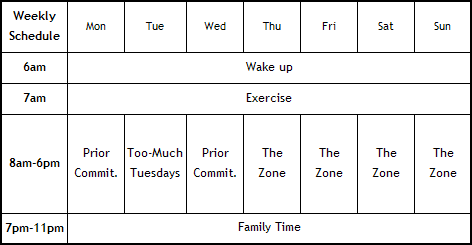
My daily chores would fit between 6am-7am and 7pm-11pm. All my interesting projects would be during 8am-6pm. Once a month, I will reevaluate my open projects and make changes to my schedule as needed. As of right now, I have prior commitments for Monday and Wednesday, at least till the end of this year. This leaves five days where I can do anything I want during the day. These five days were the most difficult to allocate. While I'd love to spend all of my time working on cool web apps like most of my projects or ZetaBee, I came to a realization that this is a never-ending, never-finished list. These projects have brought me immense joy and experience but have also taken up a lot of my free time in the past.
Additionally, these projects also conflict with my nature adventures. I want to go kayaking all day or hike a long swampy trail without feeling guilty that I'm not working on x-y-z. Then there is a big issue of getting in The Zone, "a phrase used by software developers to mean the ultimate level of mental focus." Working on six different projects in the same week basically means you don't get in the zone for any of them - too much distraction and shallow focus. I want the ability to get in the zone so I can do something with absolute concentration and utmost dedication.
My solution is to split the projects into (a) ONE-BIG-PROJECT and (b) everything else. The one-big-project is what I'll work on during Thursday-Sunday so I can get in the zone. Everything else goes to my "Too-Much Tuesdays" bucket. Every Tuesday, I will get to pick what I want to do that day. If I need to work extra on a project because of prior commitments, I can do that. If I want to go kayaking, hiking, or just have a Star-Trek movie marathon, I can do that. If I want to take a day-trip with Juliet, I can do that.
My goal is to stick to my weekly schedule without fail and push anything that would prevent me from staying on track to the Tuesday bucket. This will free me from guilt, distractions, and unnecessary busy-work so that I can work on my one-big-project for days on end. For the foreseeable future, my one-big-project will be KType. KType will be a mix of software & hardware to help people with disabilities communicate better. I'm certain that I will be writing a lot more about it in the coming days.
To make sure I stick to my schedule, I'm now tracking my time using Toggl.com. If it works well for me, I will write about my experience and methodology. Personally, I've never been too obsessive about following a routine and as long as I stick to my general schedule, I'll be more than happy. The goal here is to not stick to schedules but to create new, useful tools that help others. The weekly schedule, time tracking tool, and all these plans are just to make sure I don't go off-track, broke, or lazy.
Sun, 11th Jul '10, 1:00 pm::
Friday, July 9th was my last day at Formulated Solutions as a full-time employee and I had a very hard time controlling myself from becoming emotional during office hours. I came to Florida six years ago and spent the best years of my 20's working very closely with some really great people. I've made long-life friends here and am hoping to keep the friendships alive for the rest of my life. My boss Eric has always been more like a close elder brother than a distant authority figure. His father Thomas, brothers Brian and Kris, and business partner Ken have been a constant source of support for my work, ideas, and dreams. I will miss daily lunches with Kelly, Sandra, Jim, and Tyler. I will miss those complex accounting meetings with Vinnie where we tried to simulate 6 months of accounting transactions and their effects on the Balance Sheet in our heads. I will certainly miss discussing big database changes with David, Jim, and Linda.
It was not an easy task for me to give my resignation to Eric and I am very happy that he was supportive of my decision. I was never treated like some random employee; from the first day till last, I was treated like one of the partners. I made every decision, in the IT department and beyond, with complete freedom. So even the thought of resigning was difficult. However, in order to achieve my goals of academic research, financial independence, and personal growth, I had to do what my heart and mind told me. I resigned with the promise that I will forever be a friend and be there whenever I'm needed. Calling my last day a bitter-sweet experience is putting it mildly.
Wed, 7th Jul '10, 7:45 pm::
July has been tough. My grandpa (Dad's dad in India) has been on life-support for almost a week now. He's 77 years old and has suffered from multiple strokes and diabetes for years now. The doctors issued a "Do not resuscitate" order for him yesterday. I talk to my family in India a couple of times a day but there has not been any change in his condition. There's not much to talk about. I'm so glad that Juliet and I met both my grandparents last month.
I've been pretty busy with work and things are only going to get tougher over the next 3-6 months. Juliet is working hard to graduate in December and in the meantime, I'm planning on paying off all of my student loans. I'm on the path to change my life such that starting 2011, I can concentrate on research. Not much else to say except wish me luck.
We went to the beach an hour ago. The water is warm yet soothing. I'm afraid the oil spill disaster in the Gulf of Mexico is going to ruin the ecosystem here. A single hurricane that hits the Florida panhandle and pulls in the oil eastward, would be enough to destroy the hundreds of beaches, mangrove forests, and marine and plant life along the entire west coast of Florida for years to come. Here's hoping that doesn't happen.
Sat, 19th Dec '09, 12:45 am::
We went to our company's Christmas party tonight and had such a blast. The party began with the company president Eric Dann (my boss) taking the stage and announcing that there were prizes hidden under some of the chairs! A frantic ruckus ensued immediately and only calmed down after the prizes were found. Having grabbed everyone's attention, Eric talked about how Formulated Solutions has grown from just three partners to almost a hundred employees in the past ten years. His joke about how he sees all of us more than his own family made everyone laugh but it rang true for many of us who have spent countless evenings and late nights making things work.
Starting a manufacturing company in the US and growing steadily in the face of economic downturns, outsourcing, and tremendous competition is the very definition of entrepreneurship and perseverance. Having been a part of the company for almost six years, I feel very proud of how far we have come along through all the ups and downs. It has been a constant challenge for me to support this growth and no matter how stressful the work days get, it feels good to be a part of a company that continues to move forward.
After a wonderful dinner, the free "casino" opened and we got fake $1,000 coins each to bet on Black Jack, Craps, Poker, and my favorite, Roulette. Juliet had an amazing streak of luck throughout the night at the Roulette table and in the final round of play, bet on the number 32 and won! This put us into the lead with combined winnings of (fake) $68,300. While we didn't get to cash those coins (alas), we still came home with a nice prize. We have a busy week ahead of us and then we get to vacation in the Keys. I can't wait...
Running 50 Miles in the UltramarathonMon, 7th Sep '09, 3:00 pm::
I am 39,000 feet high up in a plane connected to the Internet. I couldn't wait to get online so I could write a few words about my race and I'm glad American Airlines has Wi-Fi now. As my track sheet says, I stopped after running 50 miles out of the 100 miles that I signed up for. After four months of intense training and considerable preparation, I ended up with a DNF - Did Not Finish. Ever since I ran my first mile in April, I had been dreading the acronym DNF. To me that sounded like failure and lack of preparation. Till the day before the race, I was terrified of ending up with an embarrassing DNF - oh the shame! And then I ran 50 miles for about 24 hours in 10,000 feet altitude and 35F temperature through mountains, jungles, and canyons paved with loose rocks, tree roots, and extremely steep slopes.
One of the greatest feelings in your life is completely and absolutely surprising yourself about your own abilities. The fear of DNF is gone and replaced by the sheer excitement of what I was able to accomplish when the odds were so severely stacked up against me. I live at sea-level in Florida, run on absolutely flat, paved, marked trail in 100F temperature with high humidity. The Grand Teton Race trail was the complete opposite and I was in no way prepared for such rocky trails and high altitude. I knew I was not training appropriately but till I actually saw the mountain trails in person, I had no idea how unprepared I was. But I couldn't give up. I was here to run an ultramarathon and I was not going to stop until I did. After 50 miles (80 kms), my feet couldn't take it anymore and I happily DNF'ed.
I have blisters on all of my ten toes, both heels, and sides of both feet. This sounds bad but the best thing is that other than my soles, I have absolutely no fatigue, muscle pain, or weakness in my entire body. This makes me extremely excited because that means my body can take 50 miles and a lot more without any engine troubles - I just need better tires. I was glad to feel completely healthy (except for my feet) because that means my exercise regimen in Florida was good. During the race I managed my food, electrolyte, and fluid intake well, I was in full control over my mind and actions, and even after 24 hours, I could have kept going.
I know I did not get a medal for finishing this time but I got more than enough encouragement to keep on running from the tons of wonderful athletes, ultramarathoners, volunteers, and race organizers. They pushed me throughout the course and kept my spirits and energy high. My friend Arthur was my pacer and flew up from NJ to make sure I kept moving forward and helped me with everything from gear, nutrition, and medical assistance. At the same time, my friend Vishal in India, Tamara in NJ, my boss Eric in Florida, and my parents and sister in India kept tracking my progress and sending me encouraging words. My family, friends, and coworkers encouraged me before, during, and after the race and that is more than I can ever ask for.
The one person who probably suffered more than me during my entire training was Juliet. For the past four months, I refused to do anything fun on Friday nights because I had to wake up early on Saturdays. Every Saturday morning I would go out running and leave her alone at home with all of the house and pet chores. Every Sunday I would sit around and be lazy so I could "recover from my long run." She encouraged me to keep training no matter how little progress I seemed to make early on. She bought most of my gear, set up the food and drinks for my runs, and even came out a few times to train with me on some of my shorter runs. And during my race, every time I returned to the base aid station after a loop, Arthur would tell me Juliet called up and said she sends me her love.
After the race, everyone asked me what my next ultra will be. Ultrarunners are serious addicts! They made lots of suggestions, especially races that I can train for while living in Florida. I would absolutely love to do more races but I don't know if I can anytime soon because of the huge time and money commitment that even short races take up. I'm taking a break from running for at least a week or two so my feet can heal up. After that, who knows. I want to get back into kayaking again and probably build something fun like our aviary in the backyard. My school starts tomorrow and I have a pretty big project at work that I need to concentrate on. I don't know how the other ultramarathoners do it but it is definitely not easy to train for one race after other. One thing I know for certain is that I loved the wonderful experience I had during this race and would most definitely do something like this again in the future when I have ample time to train. Thanks everyone for the love and support. Next time I'll bring home a medal.
Permanent Residence a.k.a. Green CardMon, 13th Jul '09, 7:55 pm::
After being in the US for nine years, as of today I am a permanent resident alien a.k.a. a green card holder. Juliet and I had our interview in Tampa and other than a long wait, everything went pretty smoothly. We had memorized so many little things about each other because the USCIS (previously known as INS) interviewers do whatever it takes to find out if the marriage is bona fide or not. If they suspect that the marriage is not real, they separate the couple and ask them questions independently, like "What was the last movie you saw together?" or "When did you last go out to a restaurant together?" However in our case, we weren't interviewed separately and the interviewer didn't ask any difficult questions because it was pretty easy to prove using our existing documents that our marriage is indeed real.
We have joint bank and stock accounts, we bought a car together, we have spent our holidays with each other's families, we filed joint income taxes, and we refinanced our house together. The view of the INS is that real couples do all these things because it makes better financial and social sense for couples that intend to stay together for the long haul to plan their finances and social lives together. Fraudulent green card marriages usually have tell-tale signs like separate bank accounts, separate assets, spending holidays away from each other etc. The other thing that made our case easy was that neither of us has ever been arrested or been in legal troubles aside from a parking ticket or two.
I am very thankful to all the people who helped us with this entire process. My coworkers Kelly & Vinnie, my boss Eric, and most of all, my friend Arthur who agreed to be the co-sponsor along with Juliet because she is in school and does not have a full-time job at the moment. Arthur was more than willing to help us in any way he could and unlike me, did not procrastinate on preparing any paperwork. INS requires that the sponsor of the green card via marriage (i.e. the US Citizen spouse) hold a full-time job to support the applicant (i.e. the immigrant spouse). If the Citizen spouse does not have a full-time job, the couple needs to find a co-sponsor with a job who is willing to spend a LOT of time preparing documents and mailing paperwork.
We hired an immigration lawyer, Mr. Creighton Shafer from Diaz Shafer in Tampa, because I did not want to get into problems because of technicalities like above. Had we not hired an immigration lawyer, I would not have known about the requirement of a co-sponsor in our specific case and would definitely have been in some trouble because of it. I'm sure eventually everything would have worked out but missing or incorrect paperwork often causes months to years of delays, during which I couldn't leave the country easily. Fortunately, our lawyer told us the right way to go and we got Arthur involved as a co-sponsor from day one.
Mr. Shafer was with us all day today and had made sure beforehand that we had every single document in order. Originally I had planned on going through this process on my own but later realized that there are so many gotchas when it comes to US Immigration laws that the best thing to do is revert to a professional. Since our case was pretty straightforward, it would have been possible for us to be fine without a lawyer and Mr. Shafer himself assured us of that, in case we could not afford his services. However, we went ahead and hired his services because honestly, I did not want to take any chances with the INS in case there were any issues. Thankfully there weren't any.
After the interview, Juliet and I celebrated by having a big lunch at P. F. Chang's in Tampa. We had the biggest dessert they offered and as usual, I ate 90% of it. We got home, napped for a few hours, and here I am.
Sun, 7th Jun '09, 7:00 pm::
I feel like I keep hopping back and forth between the mundanity of regular life and the excitement of impossible goals. Yesterday I spent about ten hours in the sun running and walking across five different towns along the Pinellas Trail. I ran 28 miles in under eight hours - my first (barely) successful attempt at an ultramarathon distance. I spent all of today dealing with house chores and pet stuff. Among other things, we're getting new washer/dryer delivered this week and the pets got shiny new water bowls.
The 28 miles yesterday really shook me up. I have run 16-22 miles many times in the past but have never experienced the amount of pain in my feet as I did yesterday. My big mistake was wearing the wrong socks which gave me blisters after about five hours. I am doing pretty well now and will be back to my usual self in a day or two. I knew that having the proper gear is extremely important for long runs and this little mistake only reinforced this notion. I also realized that I need better shoes because once my feet swell, my ankles can no longer support the high arch of my foot and pain sets in. If I am to succeed in my goal of running 100 miles in under 36 hours, I have to learn all of these issues about myself and fix them well-in-advance. In the meantime, I have enough things at back to work, school, and home to keep my occupied.
Sat, 31st May '08, 9:25 pm::
Have you ever truly believed that you were right yet everyone who cares about you thought you weren't? All you want is for people to be happy for you yet all you get is rebuke and dire warnings. You've taken a big risk, made a gutsy call, and understand the consequences yet your loved ones treat you like a reckless dolt. The ones you relied on for support and advice make you feel guilty for doing what you honestly feel is the right thing. Have you ever felt like that? It's debilitating. Why can't my loved ones just be happy for me for once and stop with the negativity? I am well aware of what can go wrong. If you can't be happy for me, then stop trying to make me feel sad. That is all.
Living as if tomorrow is your last day?Sun, 2nd Mar '08, 12:35 am::
It always bothers me when people say you have to live your life as if tomorrow is your last day. That's because if tomorrow is my last day, there are many things I will do that I would certainly regret if I'm alive on the day after tomorrow. Given just twenty-four hours to live, most people including yours truly, will just party non-stop for as long as they can and then retreat into delirious seclusion because of the immediate threat of death. Living your life as if you're going to be dead before the next mortgage payment comes up is pretty irresponsible and not a good motto to live by. On the flip side, living as if you have all the time in the world to do everything you want just makes you lazy and procrastinate without ever accomplishing anything.
People are bad at making 5-10-15 year life-plans and except for a very few people (like med-school students and retirees), nobody knows where they'll be in a couple of years. What made me think about the appropriate length of the ticking-death-clock is a mention of Prof. Randy Pausch online. About six months ago I watched his moving "Last Lecture at Carnegie Mellon" online. He was diagnosed with pancreatic cancer in September 2006 and given three to six months to live. His last lecture was in September 2007 and thankfully, he is still vigorous and active till date. Here's a brilliant, energetic family man who has lived the last 18 months thinking he'll die within the next three months. And to top it off, he has went on to accomplish his childhood dreams (like practicing with his favorite sports team and getting a talking role in the next Star Trek movie) as well as ensuring his wife and kids have wonderful memories of him.
In a span of three to six months, you can do a lot. Travel across a continent, write a book, build a swimming pool for the kids, and go on a long road trip with your best friend. You can live each day to the fullest while not driving the people you leave behind crazy. This is quite achievable and exciting if you think about it. Today is March 2nd. If everything you ever wanted to do, had to be done by September 2nd, what would you do and when? No, you can't wait till Christmas. You can't put off going skiing till November. You don't have infinite money and your savings aren't enough to support six months of bills on top of all the fun you want to have. That means, you have to keep your job, you have to continue to pay auto insurance, and you have to be responsible about your actions. All this, while the six-month clock is ticking.
I can't imagine what Prof. Pausch is going through, especially with the chemotherapy treatments and tremendous media exposure, but I know it in my heart that whenever he hugs his wife and kids, he does it like a man who has three months to live and wants to make every moment of it memorable for the ones he leaves behind.
I don't want to believeSat, 27th Oct '07, 8:15 pm::
People that know me well, know well enough that I am completely devoid of any beliefs, faith, superstitions, and paranormal inclinations. I don't believe in ESP, ghosts, mythical creatures, or UFOs. I don't "believe" in science, rather I have a good foundation in scientific theory and principles with a pretty decent understanding of the universe we live in. I don't claim to know or understand everything and so even if I don't know what caused the Big Bang, I'm perfectly fine with my lack of scientific explanation for it. Regardless of all of this, my entire past week has been pretty damn weird.
I woke up last weekend and sent this to Tay online: "I had a dream that I was vacationing in Gujarat (a state in India) in the Gir Forest lodge house, surrounded by tigers and lions. My family was there, so were you, Anthony..." I didn't get into detail since he was leaving but the dream wasn't about the lions attacking us. They were trying to get inside the lodge to get away from something. Two days later, I came across this tragic article online: "Five Lions electrocuted by poachers in India." I hadn't seen any documentaries about Gir in a long time. I hadn't watched any Animal Planet or Discovery shows about big cats nor read any Nature articles. This was completely out of the blue. Color me spooked.
The rest of the week was full of little coincidences, too many to list. Today turned out to be yet another unusual day. I don't know what's in the air but for some reason, I was treated extremely nicely when I went to the grocery store, deli, and then later at a Chinese food place. I know everyone has days when people seem extra nice (or extra mean) but I'm talking double free food from a fast-food chain run by Pepsi. People were so nice today that I kept wondering if something was wrong with me.
A few minutes ago, I finished my food and started reviewing the stats for Chime.TV. I was about to lament that the growth is not accelerating at the expected pace when I popped open a fortune cookie to find these words: "They will be grateful that you cared enough to make it."
Like I said, I don't believe in anything. I don't believe I am here for a purpose, I don't believe everything happens for a reason. I do know that I have managed to overcome some pretty tough hurdles with support from my loved ones and a ton of luck. Lots of strange things happen in my life that I can't seem to explain. However, the fact that I don't understand why something happens, doesn't mean I am going to believe it happened because of some mystical miraculous reason. Life is just plain weird.
Sun, 22nd Jul '07, 11:25 am::
Earlier this week Tay and I went to Silicon Valley, California to participate in Mashup Camp 4 (pics here). A mashup is a website or application that combines content from more than one source into an integrated experience.
We showed off Chime.TV (as a video mashup that combines top 10 video websites) and people loved it so much, we were voted the Best Mashup and won 1st prize (wearing my reddit t-shirt)! Here's ZDNet interviewing Taylor to show off our mashup entry (video here). Our kickass webhost for Chime.TV, SingleHop also interviewed us earlier this week. Highly recommend them for the great 24/7 dedicated support and an awesome performance/price ratio.
It was a great experience to visit Silicon Valley for my first time ever and meet so many brilliant people. I met some pretty smart folks from the development teams of AOL, Google, HP, Microsoft, Yahoo, YouTube, and more. My super-crazy-smart college buddy Tim dropped by too. I had a lot of fun hanging out with Tay's friends at eventful - Chris & Nate and also John & Liz.
I haven't been online much after we got back. Yesterday I went to Busch Gardens with my friend Heather and her roomie Bonnie. We saw a lot of cool birds and animals but it rained soooo hard that all rides were canceled. We ended up returning home early and just watched a couple of movies instead. Good thing about Busch Gardens is that Florida residents can come in multiple times for free once they buy an annual pass for just $5 more that of course I did.
It's my lazy Sunday afternoon now and I'm just relaxing and unwinding after a pretty exciting week. Time to sit back and just enjoy Chime.TV now.
Lament not, fellow IndianWed, 25th Apr '07, 12:35 pm::
I am at work right now, on hold with Dell, trying to renew the warranty on some servers we purchased last year. I can easily whine about how awful the overall support nightmare is, having talked to over twelve people in the last two hours. But right now, I want to sadly talk about something that has been bugging me for years now - the pitiful tone and the lamenting language of the average Indian call center employee.
Having lived in India for the first twenty years of me life, I am well-aware of the social constructs, language barriers, and job market woes. So I have nothing but utter respect for the hundreds of thousands of hard-working, honest call center employees. I have a few friends in Delhi that work for outsourcing firms and many of these kids are brilliant. I am hurt every time I hear anyone stereotyping and insulting them online and offline, just for being different and hard to comprehend. I had a strong Indian-accent when I first came here and I still have problems being understood sometimes. Being packed in a cubicle with 3 others, stuck on a phone with irate customers for ten hours a day is not an easy way to feed your kids. So I understand how difficult things can be.
However, what drives me crazy is the pathetic "Sorry Sir," "Thank you very much Sir," "Please wait Sir" language that these folks are forced to use. It makes me ashamed to think that my people, even after sixty years of Independence from the British, still have to portray a public image of servitude, inferiority, and desperation when interacting with non-Indians.
The blame lies not with the workers. It lies with the management, often-times Indian, that enforces these scripted rituals of verbal enslavement. The employees maybe humble yet proud Indians but since their paycheck relies on them using these "Sir, Sorry Sir, Please Sir" interjections, they have to behave like dismal Third-World outcasts. What angers me the most is that these are well-educated, highly-skilled, respected people forced to behave like servants for some mythical foreigner 8,000 miles away. When I interact with people here in US, this is they behavior they expect of me. I'm sorry but if anyone expects me to be a sorry little Indian boy, you can bet they'll be my personal dartboard for a long, long time.
If you have ever called customer support and have been frustrated because it is hard to understand the person at the other end, realize that they have the same problem understanding you. All I can say is speak clearly and respectfully. It's not their fault your cellphone battery doesn't charge. What right do you have to insult a complete stranger solely because they sound different? You certainly wouldn't pull that on a cop with a different accent, so why are these hard-working individuals fair game for insolence? If you truly want to retaliate against the company, stop buying their crappy phones.
Now if this message ever reaches a call center employee, I have just one single request for you. Please Sir/Ma'am, be proud of yourself Sir, and boldly refuse to use the Sorry lines that your Respected Boss Sir Kindly Requested you to use Sir, Thank You Sir.
So let goMon, 20th Nov '06, 7:15 pm::
Casually talking to a friend today I realized how one of the personality traits that I've acquired over time has changed my life so drastically and mostly for the better - the ability to let go. Letting go of someone or something is different than forgiving or giving up. I mean let go in the same sense as Chuck Palahniuk's Narrator in Fight Club remarked, "The ability to let, that which does not matter, truly slide."
For a species that is free to move around, we are remarkably predisposed to hanging on. As toddlers, we hold on to our blankets and teddy bears. As kids we latch on to our toys and mommies. In youth, we hold on to our music and friends. And as we grow older, we cling to our families, jobs, cars, houses, and every person that we've ever cared for. We just can't seem to let go of anything. Hanging on is what we do!
It is not a secret that people change, sometimes for the better and sometimes for the worse. The friend that cared about you so much last year doesn't even think about you anymore. The little boy down the street you liked saying hello to, doesn't seem all that respectful anymore. When a person changes, we all notice it. You knew it the moment your cousin got married that she turned into a whole new person. When a person changes, we also know if they changed for the better or worse. Your friend for the worse and your cousin for the better.
The problem is that we ourselves aren't willing to incorporate this change into our world view. We don't want to admit that now that this person has changed and is suddenly treating us like crap, that we should just let go of them. We keep trying to get their attention, to show them that we are still worthy of their affection. We need to let go. You need to let go. The relationship is over. The friendship is over. Just let go.
Letting go doesn't mean you stop talking to family or friends when they're in trouble and are more work for you to put up with. Letting go means when someone clearly no longer wants to include you in the next episode of their life, you gracefully accept that your character was killed off and go back to starring in the remaining forty-seven other shows. If that's not enough, find new people and become a guest star in their lives.
It took me a long time to come to terms with the fact that many people no longer want me to be an active part of their life; some very close friends in the years bygone. Often I blamed myself for the turn of events, thinking I must have done something to push them away. Turns out, it wasn't me or anyone else. It wasn't even them sometimes. Life changed them. They moved on and were hoping I would too; the sooner the better.
When it takes more effort to maintain a connection with someone than the mutual benefit and support we obtain, it is not worth trying to make things work anymore. While we shared some good times in the past, if you don't have enough time for me anymore, it is in my best interest to let go and find someone else. The longer we hang on to after the bond's broken, the more it hurts when we finally let go.
Letting go doesn't have to be painful or sad. It can be a wonderful culmination of good times had. I let go of my angel after she helped me finish my first marathon. I said bye, smiled, and never looked back. I still think fondly about her and I'm certain it's because I let go of her before she started ignoring my phone calls and emails. If someone is meant to come back to your life, they will. Otherwise, just let go.
Different parameters of relationshipsFri, 18th Aug '06, 12:25 am::
On the surface, this has been a relatively normal week for me, with the usual deal of work, bills, home, chores etc. Nothing really out of the ordinary. Well almost nothing. The two read-but-unreplied emails waiting in my mailbox, sent by the two strongest humans I personally know - my dad and my uncle, keep staring at me every time I check my email, as if mutely yelling at me to hit 'reply' and type away something beautiful and worthy of their dignity. Alas, it's not easy.
My dad sent me an email last week telling me he missed me. It was so loving and sincere that when I showed it to a friend of mine, she wanted him to adopt her. Few days later, his brother, my Paresh uncle, emailed me to tell me how my cousin Keval is slowly getting better. While mentioning that he was pleased to read my views about life on my 'blog, my uncle wrote about his thoughts on life, knowledge, and relationships. It didn't occur to me until now that while millions of people live their entire lives without even saying "hello" to their parents and elders, I take for granted all the support and love in the world that I get from my family without even asking for it once. And then when someone tells me they love me or miss me, I find it extremely difficult to respond to them. Woody Allen's America does that to you.
I wouldn't even have begun writing this 'blog entry tonight had I not clicked on this video of father & son unknowingly. Team Hoyt is a father-son team of Dick & Rick Hoyt, "from Massachusetts who together compete just about continuously in marathon races. And if they're not in a marathon they are in a triathlon - that daunting, almost superhuman, combination of 26.2 miles of running, 112 miles of bicycling, and 2.4 miles of swimming. Together they have climbed mountains, and once trekked 3,735 miles across America." It sounds like typical father-son adventurous duo till you realize the son, Rick, can't walk or talk. The father pushes, carries, lifts, and pulls him from the start till the end. Every year at the Boston Marathon, this team gets the loudest, most-cheerful standing ovation. I know this particular video has some typical-cheesy music but that didn't stop me from sobbing for 4 minutes and 14 seconds, and then again for 4:14 when I hit replay. Last time I was in India, Google Videos weren't accessible from there. I think it's a good thing because I don't think either my dad or uncle will be able to control their tears if they saw this video. I mean it made me so weak in the knees that I decided to shed my fake outer-shell of "I'm so awesome and my life is so great" and admit that I sobbed and cried uncontrollably when I saw the video.
Like my dad always says, I rarely propose concrete well thought-out arguments on my 'blog entries, and usually ramble aimlessly. Today is no different. Yet, almost always, I have underlying themes. I guess tonight, it's the latent energy to persevere. By latent energy, I mean the hidden strength that these two stalwarts in my family seem to possess since birth. Ever since I was a kid, they were the two strong brothers I could always look up to for help, advice, and guidance. To me, they were and are now more than ever, the resolute pillars of persistence. In my eyes, nothing has changed, rather they both have shown time and again that they're getting wiser and more down-to-Earth by the day.
But in their eyes, something has changed. They now think of me as a mature grown-up man that they can share their views with, as equals, instead of just teaching me like I'm a student and they're teachers. That is something new to me. Suddenly, I'm seeing them in light I've never expected, as real humans with strengths AND weaknesses. While my dad and his elder brother have always tried to be my best friends, I'm new to this aspect of theirs - the side in which they stop being perfect figures of authority and become my friends with unhindered emotions and honest feelings - no pretense of being the bigger man.
But I'm so used to them being the head, the father-figure, the authority, that this closeness is leaving me speechless. The weirdness is of course that I feel completely comfortable in writing about it here in public, I guess, because I am so used to being honest and open here. Writing becomes difficult as soon as I have a specific audience.
On my 'blog, I write for everyone and no one. I write for me and for you. But in an email or phone conversation, I have to talk direct with one person and then depending on who that person is, it's either casual or formal, easy or difficult. For now, it's a new experience for me to get to know my dad and uncle on a man-to-man level. It sounds so generic and mundane when it happens to other people but like my uncle said, "as you go in deeper into life, you will open new horizons of knowledge and see different parameters of relationships."
I don't want to be richSun, 30th Jul '06, 1:55 pm::
I just read a surprisingly blunt article by Felix Dennis, a British publishing tycoon, titled "If you want to be rich, first stop being so frightened." He's brutally honest in saying how he became rich and what all he had to do on the way to get there. His shortlist of who wouldn't get rich includes these gems: "If you cannot bear the thought of causing worry to your family, spouse or lover while you plough a lonely, dangerous road rather than taking the safe option of a regular job, you will never get rich. If you have artistic inclinations and fear that the search for wealth will coarsen such talents, you will never get rich. (Because your fear, in this instance, is well justified.)"
I always wanted to hear a really rich guy say everything he said in the article because at the back of my mind, I knew that was exactly what one would have to do. Sure, there are exceptions to every rule, but by and large, money and power aren't attained by the kindness of your heart and the virtue of your soul. I feel vindicated in a way because while I (just like my father) know exactly what I'd have to do to get all the way up there, I can't make myself do it.
Addressing his shortlist, I don't really have much of a fear of failure anymore. I used to but after tons and tons of disasters, failure is just another non-event to me. I rarely care what neighbors think (except when my lawn is ill-kempt). I can work 18 hours a day for a year if I want. I know I'm smart/good/capable enough to be filthy rich. I know getting rich is a game and I can play it if I put my mind to it. However, I'd rather not.
While I have the tenacity and drive to achieve "success," my definition of success is different from most people. I want success in invention and innovation, not in investment and influence. I think once you are above a certain IQ-level, you can pretty much do anything you set your mind to. After all, if you are smart enough to understand particle physics, you can understand the Ricardian Model of Comparative Advantage or Loss Distributions and Survival Models just as well. It's a matter of selecting which field you like; some just pay much more than others.
My favorite example is Investment Banking because I think it has the highest pay/effort ratio among all the typical jobs out there. Typical, because anyone with basic financial resources and a triple digit IQ can get an MBA and become one if they set their mind to it. It's not something like acting or sports that require talent or physical characteristics. It's not operations research or econometrics that requires intense appreciation of mathematics and statistics. If I had wanted to get comfortably rich, with say a salary of $150k-$200k by my late 20's or early 30's, I'd be an investment banker. It's not that complex really. Now writing a script that isolates specifics GUIDs from the registry and generates .Net code for a COM wrapper to extend every single class of an existing DLL written in VB in order to enable access the indexed properties of an object from PHP so that I can migrate and merge the data from two Btrieve 6 databases to a Pervasive 9 database is complex. And pretty much always goes unnoticed because nobody really understand what the hell I just said. But I like it. No, I LOVE it. And I'd rather be doing that than making money - because this makes me happy.
We have a choice in what makes us money. We have no choice in what makes us happy. For me, it's the unwavering desire to spend my 30's researching mundane computational or economic theories. For others, it's getting whatever job pays well enough to support their golfing ambitions or their family. And for others, it's eating pie. Hey, whatever makes you happy.
As for me, I'll have the PhD please. And would like to be comfortably poor as per Felix Dennis' Wealth Guide: £1m-£2m in assets.
Big Picture vs. Small PictureWed, 16th Nov '05, 8:00 pm::
Disclaimer: It saddens me to write this 'blog entry because I know my family will read it and won't like many parts of it. Sorry but you won't be able to use this 'blog entry to show off my success to everyone. I haven't run a marathon today and I haven't written any software this week that'll change the Internet. But it makes me happy to write this because I think it's time for a reality check for myself and for everyone that I love.
The Game: It's a little game I call Big Picture vs. Small Picture. This is not about truth vs. false. In this game everything is true for only true facts are admissible. I can testify that nothing in the following statements is even remotely false. So let's get started.
The Small Picture: Even though I have a great job in US, I hardly have any savings. I can't send any monetary gifts back home to India for my only sister's wedding in January 2006, even though my cousin in UK pretty much paid for his sister's wedding and more. In fact, I spend more money on my cats than I send back to India. Any time my relatives in US ask me to come visit them for holidays, I decline saying I'm saving up to buy tickets to India for my sister's wedding. I admit to them that if I don't save each month, I won't be able to pay for the India trip. Whenever someone suggests that I get arranged married like my sister, one of my first excuses is that I can't afford to marry. Word gets around and now, I'm officially broke in the eyes of my family & relatives.
I wasn't always "broke". In fact, three years ago back in college, I was supposed to be doing pretty well with my high-paying student job. Just earlier this year when I went to India I was even seen as what you might say... "rich!" But for some reason, not anymore.
Immediate Analysis: If you just look at the small picture, and it is in fact quite true, clearly then it would seem that I must be bad at managing money and/or I don't care enough about my family in India to chip in for even a small part of my loving sister's wedding expenses. Somewhere in the last few months I went from being pretty "well off" to living "paycheck to paycheck" and since I am in full control of my fiscal habits, I'm the one to blame. Thankfully, my parents are very understanding and have never demanded anything from me. Never ever. For this and more, I love them more than any son can. Nevertheless, it appears to all that I'm reckless and failing. Hmm. Let's look at this scenario from a different altitude.
The Big Picture: In this round, we forget all the pesky details of day-to-day life and think BIG. A little over five years ago I came to US with a dream... the ever-so-romanticized American Dream. After years of reluctance, my dad finally, at the behest of my lovely sis, told me to go forth and conquer the world. I'm sure he didn't expect me to wage military wars on the entire world, but instead wished me best of luck to achieve everything I wanted in my life. I flew in to the magical land of the United States of America all cheery-eyed and dreamy. My mom and grandma were glad that their kid was finally going to get good higher education - after all who doesn't want an esteemed PhD dork in their family?
I spent four years in Rutgers New Jersey, half of them living with my aunt and uncle who still do their best to support me whenever they can. Two bachelor degrees with highest honors later, I moved to sunny Florida for a once-in-a-lifetime chance to head the IT department of a small-but-rapidly-growing company. Now that I was finally living on my own, I could do things I've always wanted! A three-pc home-network? Check. True bachelor-style bean bags? Check. Cute little pets that my sister and I have wanted since childhood? Check! Everything's great. I go to India in April '05 and everyone is happy for me. I'm a success!
I notice real-estate prices in my area go through the roof, especially the properties near the Gulf. It's either buy now or be priced out of the housing market for decades. Having realized that without physical assets, creditors in US don't care about you at all, I pooled all my resources together for the big buy. In two short months, I bought a cute little house near the beach. Now next year when I try to consolidate my three variable-interest (eeek) student loans, banks will not reject me outright because I shall be in possession of the revered home equity.
Immediate Analysis: Big dreams necessitate disciplined efforts and uncompromising patience. It took some time but it appears to anyone that I've managed to fulfill quite a number of academic, economic, and personal goals. Overall, things are great if you ask me. No bad marriage, no expulsion from college, no criminal charges, no pending lawsuits, no housing troubles, no bad debts, no employment issues, and no chronic illnesses. I'm crossing my fingers and hoping things stay just as good. I'm one lucky son of a gun. So... if everything is this peachy, what's with the pesky details I mentioned in the small picture above? It's all about the proper focus.
a. Focus - Adjustable: You need a telescope to look at distant planets. You need an electron microscope to research how to better fabricate the carbon-nanotube fibers that strengthen the structure of the spacecraft that will get you to these distant planets. Notice the complexities between the two sentences. Dreaming, big-picture satellite viewing is simple. Even though it requires planning, experience, and wisdom, it won't get your hands messy. On the other hand, doing it, living in the nitty-gritties of actually implementing something is a dirty job. We dream in big screen but alas we live in the small picture. And the day you stop adjusting your focus is when you're stuck living a life you cannot take control of.
Very often, people, including yours truly, get so entrenched in one view, that they fail to see things for what they really are. While immediate events have immediate consequences, they also have long-term effects. How we handle situations in the short term impacts what will happen in the long term. My dad once told me that intelligence is the measure of how long does it take a person to walk into a room and understand everything that went on, is going on, and will go on. I propose a corollary that intelligence is the measure of how long it takes a person to switch from small picture to big picture and vice versa. What does this have to do with me you ask? Let's see.
b. Focus - Sticky: The problem with changing focus is that it doesn't want to change. We don't like to see things differently than we already do. It goes outside our comfort zone. You can get a new pair of running shoes today but it's so much more comfortable to spend that money on junk food and sit back & watch TV all evening instead of months of persistent training for a marathon. Notwithstanding my trifling excuses, I can buy a plane ticket to anywhere in the US today and have a great time with my family & relatives. It is so much better than putting $150/month extra towards the principal on my home mortgage. I used to be so free with my money; back in college when my primary goal was getting a degree. But I have to constantly get into the big picture view and remind myself that now I'm in the hardwork and struggle phase of life - these are the years I need to be saving up for the next phase of my life - graduate studies.
Selective Sacrifices: Nobody's saying that I need to give up on enjoying my life in order to maybe some day achieve my ambitions. If you saw me at the BBQ party at my house this weekend, you'd very well know I'm not giving up on any fun. However, I have given up on the extravagant lifestyle that I so lavishly savored during my pre-mortgage era. No more $500 impulse shopping bills and no more $100 on martinis. Just like no more cheese and pizzas till my health is back to my doctor's approved standards.
You cannot sacrifice today for tomorrow and you cannot spend everything today and have nothing for tomorrow. It's a delicate balance between the two and the sooner a person realizes this, the better. For me, a house is an investment. I was more than happy living in the 100 sq.ft. bunker in New Jersey. I don't need a mansion to keep me happy. To me, my house means that instead of spending and giving away like the young grasshoppa, I'm saving like the ant. Adhering to ancient wisdom is a GOOD™ thing.
Consequences for me: It's great that I have a house because when I decide to go for my PhD years from now and devote 5-6 years of my life to science, I will have a pool of savings I can rely on, without having to worry about food and next month's rent. Many people pursue PhDs right after their Bachelors, mostly living like poor college students throughout the course. I didn't want to. I wanted a break between BSc and PhD. I want real-world experience. I want to know that some day my research and inventions will actually make a difference. Hence, I'm glad to have a job where I face production scenarios every single day that demand novel theoretical solutions.
I've said this over a hundred times already that if I cared about money, I'd be selling plastic granules in Kolkata right now. It is a very respectful trade and many people I know back home live happily every after with their families by engaging in wholesale businesses. However, it is just... NOT ME. I'm a student of science, always was, always will be. Till the day I died I would regret the 8-10 hours a day I spent trading because that is not what I wanted to do. My problem is that while I can remind myself this on a regular basis, everyone around me forgets it. Then I get compared to my cousin in UK, whom I love dearly, but have entirely different ambitions in life from. His noble ambition, from my personal knowledge, was to provide the best standard of living for his family. He woke up each day knowing that he needs to make ends meet for his family and that it is up to him now. He is my personal hero because on an absolute scale, what he does requires a lot more dedication and perseverance than what I do.
Consequences for my family: If my parents wanted the same thing from me as my cousin, they would have made it very clear from day one that my aim in life should be to send $x to India every single month. But they didn't. They told me to get the best education I could and fulfill all of my dreams. They supported me throughout and I'm happy that they did. Yet, every now and then, people question if they did the right thing, if I am doing the right thing, if I still love my own family, if Brazil is going to win the next World Cup Soccer. People question, people talk, people raise unfounded doubts, and above all, people make mountains out of mole hills. That's what people do. And that is when things go sour. And that is why I feel so compelled to write a pretty revealing personal 'blog entry like this one to make things perfectly clear.
I feel like I've always been lucid and honest to my family and relatives, in fact, to pretty much everyone that asks me a question upfront. I never lie about serious issues though I may lie about how many girls I've kissed ;)
Honest Ramblings: I feel excited to tell my family every other day that OMG I LOVE YOU. There is nobody else in the world I love more than you guys. If something unfortunate happened tomorrow and my family needed anything, I would take the next flight to India to help out (after notifying my work of course; not gonna run away boss man! Don't worry). But I wonder, since when did I become a BAD son? I thought I was doing everything right in life - in the big picture sense. I never said I was perfect and I was pretty much pathetic during the months of August-October this year when I was down with god knows every illness known to pirates in the 1700s.
Penultimate Moanings & Whinings: It's no surprise that a single person living alone, far away from all family and friends, will get pretty down and depressive when faced with prolonged chronic illnesses that prohibit all forms of social interactions. In English, that means hell ya, I was sick, alone, and did I mention sick?! Of course, I was sad and weak. I couldn't even hang out with my friends! I'd have to be pretty crazy in the head to actually enjoy any of that. Worst of all, I spent all my savings on medical bills and ended up breaking my promise to my sister that I'll do my best to send her a small gift soon. I'm sad that I broke a promise but I'm crushed that people treat me like it's my fault that I had all these medical expenses. Ok... so I don't have an extra $1000 lying around anymore. Does that mean I'm a loser or a weak person altogether and need support from every person who walks by just to hold myself together in life? HELL NO!
The Winner: Life's a game. It's a balancing act - between truth and false, good and evil, right and wrong, big picture and small picture. Who's the winner in the match Big Picture vs. Small Picture? Neither side exactly. Only the ones who can juggle the two fluently will "win" the so-called game of life.
Sometimes, people stop juggling. If the people who love me the most, don't stand back and take a look but instead suspect my intentions, capabilities, and strength, it's gonna be an uphill climb. I can never stop loving them but I'm kind of disheartened that the ones closest to me assumed that I've somehow forgotten what's important. I don't think at this age and stage in life I have to give any explanations on why I spent $300 treating my cat's bleeding foot. I don't expect anyone to understand WHY I like my cats, but I do expect them to not to criticize me for the day to day decisions I make in my life.
It comes down to the classic "I'm old enough" debate now. I'm old enough to know what I'm doing so please stop judging, taunting, and sneaking in remarks about what I do or not do. If I'm about to make a major decision, I will always ask the people I look up to. For instance, I had a long chat with my dad late last year about buying a house. Taking his advice, I didn't buy a house then. However, I revisited the issue a few months later when my situation had changed and ended up buying a house that I realize is an even better fit for me. I'm not saying I made absolutely the most perfect decision ever (man... my roof still needs repairs). I just like to think that I made the most sensible decision given the circumstances and stood firmly by it after weighing in the positive and negative consequences. The positive consequences being that I'll build equity that will help me later in life and the negative being that I won't have lot of free money lying around every month anymore.
If you've read this far then it's only natural that I thank you for paying attention and listening to what I had to say. Know in your heart that I love you more than anything in the world and that I will do anything possible when the need be. But if there is no crisis, then why not let me pursue my dreams and have some fun on the way? And for flying spaghetti monster's sake, stop worrying about me! I'm doing pretty damn well.
PS: Please send me money. I've been eating cat food for two weeks and have no money to feed myself or my cats now.
PPS: Just kidding about the cat food. I'm still a vegetarian :)
PPPS: Don't forget the money!
Sat, 3rd Sep '05, 1:30 am::
Pictures of Katrina's Aftermath.
Talking to random people online and offline in last few days I've realized that are there are lot of people who say "Oh I'm not watchin the TV or any news because it's too depressing." What they really mean is that "I am burying my head in the sand to ignore what's going on in this country because I am a coward." I think if something like this, i.e. the largest natural disaster in almost a century, doesn't move you, then you are a heartless monster. This is a time to help, to donate whatever you can, to show support - NOT to ignore and hope that this goes away and the news media can finally go back to reporting important things, like missing white teenage girls on Springbreak-Islands.
These same people today who are blocking all news and instead watching re-runs of "Everybody loves Raymond on TV are the ones who were glued to their TV-sets on Sept 11, 2001. Why? Because what if the terrorists attacked their little town in the middle of nowhere?! So they studied the news, read everything there was to know about Osama Bin Laden, and after extensive research miraculously concluded that waging a war on Iraq would stop all future acts of terrorism on the American soil. I'm sorry but the sheer stupidity of the common man is something that always amazes me.
Everyone was so up-in-arms about everything going on after 9/11, the invasion of Afghanistan, the "War" on Iraq. And now? Nobody cares! Why? Because well, we don't get hurricanes in Maine. Or Wisconsin. Or wherever these people happen to be. It is a sad day when apathy rules. From the common man to the Federal Govt.
The disaster that was KatrinaThu, 1st Sep '05, 8:20 pm::
Exactly a week ago I casually mentioned that there was another hurricane on the horizon and wondered how it would shape up. Not even in my worst nightmares could I have witnessed the devastation that Hurricane Katrina has caused in the last five days. It was a Category Four hurricane when it hit the coast of the state of Louisiana on the gulf coast above the Gulf of Mexico.
Before it hit Louisiana, it passed through South-Eastern Florida as a Category One hurricane and it slowly gained strength sitting above the warm waters of the Gulf of Mexco. By last Thursday, everyone knew this was going to be a major hurricane with wind speeds of above 150 mph. My friend Kathleen called it the classic book case - the perfect example of a storm - something students decades from now will be learning in classrooms, on how it formed, how it gained strength, how it moved with tremendous force, and finally, how is destroyed every shred of civilization on half the gulf coast.
As many are already saying, this is going to effect pretty much every person in the US in a very short period of time. Katrina was not a typical storm or minor hurricane that ruined a few neighborhoods and took a few lives. Katrina is absolutely one of the largest natural disasters US has ever faced and the aftermath of this on society, politics, and the economy will be very horrendous.
Let's begin with the area most affected by Katrina - the City of New Orleans, Louisiana (NOLA). Majority of the city of NOLA lies about ten feet below sea-level. And as you can see in this map, NOLA is bordered by two major lakes, a river, and the Gulf of Mexico. On top of it, the city is literally shaped like a bowl. It was no surprise to anyone that if the city was hit by a major hurricane, the bowl would fill up with water and there would be no way of draining the water because the sea-level is actually higher than the city.
And then it happened. Katrina hit slightly east of NOLA, barely missing the city, but the damage was done. The levees and barriers that block the river, lake, and sea-waters from flooding the city neighborhoods broke from the sheer water pressure. When a hurricane makes landfall, the ocean swells upwards and sea-water rushes inland. This is different from the kind of tsunami that hit South East-Asia late last year. Tsunamis travel very very fast, hundreds of mile an hour, and shock the coast with their impact, kinda like slapping someone really hard, sometimes multiple times, but then pulling away instantly. Storm surge is when the sea-water floods inland because of the suction created by winds on the water-body, as a result of which, the water does not recede back into the ocean as long as the winds persist. A storm surge is like sitting on someone's chest and gradually applying more and more pressure till their ribs burst and getting up slowly afterwards. Of course, both are just as ravaging to human livelihood.
So now you have a bowl-shaped city of over 1.3 million (13 lac) residents that got filled with water. There just isn't any way out other than physically pumping all the water back into the ocean and lakes - a process which will take months and months. For the first time since the San Fransisco Earthquake & Fire of 1906 has a major city been absolutely ruined like this. Eighty-percent of NOLA is still underwater and it will continue to remain so.
NOLA isn't the only city affected by Katrina. Hundreds of cities and small towns were affected. From the looks of it, Waveland, Mississippi, located north-east of NOLA was affected the worst as pretty much every house in the town is levelled. The town is no more. There are no houses or buildings standing, no electric poles upright, the trees have been uprooted or snapped into pieces, and for all intensive purposes, zipcode 39576 is non-existant henceforth. And this is but one of the hundreds of towns directly affected. WalMart has closed 123 stores and UPS has suspended shipment to 900 zipcodes indefinitely. This is about three to four percent of the entire country of US.
The immediate economic impact is something people always feared - rising price of gasoline - petrol & diesel. I purchased gas at $2.599/gallon yesterday and it's above $3/gallon today in my city. Elsewhere, people are paying upgrades of $5/gallon and many small towns in states like North Carolina, South Carolina, Georgia, and even Wisconsin have run out of gas. It is no secret that the entire economy of US relies very heavily on gas and rising prices could mean economic depression. The Port of Southern Louisiana is the largest port in the US, fifth-largest in the world.
Here is something that has blown my wits away. Back in June of this year, FX Network aired a mock-umentary titled "Oil Storm" (thanks Eric!) The synopsis of the story is that sometime around the Labor Day weekend (that is the coming weekend), a Category 6 hurricane in the Gulf of Mexico slams into Louisiana, crushing the city of New Orleans and crippling the vital pipleline for refined oil that is Port Fourchon (more details). The movie "examines the ripple effect of that event and the ensuing cascade of disasters associated with it..." Basically, the first part of the movie about the hurricane has already come true and the next part, about oil prices is already coming true. You can read the synopsis yourself to see how the story unfolds and ends, but the scary thing is, back when the movie aired, everyone was mocking, insulting, and criticizing it. Now, not so much. Nobody believed that a hurricane could drown NOLA, cut off the nation's oil pipeline, or set the oil rigs afloat. Yet that is what happened. This time truth is eerily exactly like fiction.
The damage to public and private infrastructure is only overshadowed by the utter senseless degradation of human lives. Right now, hundreds of thousands of people in NOLA area are thirsty, hungry, have no shelter, and are being terrorized by street gangs. Reporter Anya Kamenetz writes, "the city of New Orleans has a 34 percent poverty rate, triple the national average. It's about 70 percent black. White flight, first to Jefferson Parish and then across Lake Pontchartrain, to the North Shore, has accomplished the desired aim of de facto segregation in the public schools, which are 93 percent black in Orleans Parish and some of the worst in the country." Now, the aftermath of the hurricane is not only a humanitarian issue but also a racial one. Right-and-left people are debating whether the US Federal Govt. is doing enough or not, whether the National Guard would have been moved to NOLA for support any faster if there was a higher percentage of white citizens.
Yahoo! has managed to stir up some controvery regarding two pictures captioned slightly differently. They even issued a public statement and removed one of the pictures. Apparently, the caption under the very dark skinned person said " A young man walks through chest deep flood water after looting a grocery store in New Orleans" while a picture of two light skinned persons was captioned, "Two residents wade through chest-deep water after finding bread and soda from a local grocery store..." So dark people "loot" while fair people "find" right? The photographer of the second picture disagrees but for now, the issue has raised many a question.
Since eighty-percent of NOLA is currently underwater, some places as deep as twenty-feet, the only pictures and videos available of most areas are from helicopters. While thousands of people are being bussed from the drier areas in NOLA to nearby cities like Houston, Texas, there are thousands of people still stuck in their houses. Hundreds of dead bodies are floating on the streets and rescue workers can't do anything because they first have to help the victims who are still alive.
Any attempt to compare Katrina with the tsunami of 2004 is looked down upon right now because there was a tremendous loss of life in the latter. Additionally, tsunami was unpredictable while the weather channels along with the National Hurricane Center were blasting warnings for days before Katrina made landfall, giving people enough time to evacuate. Moreover, damages from tsunamis were not preventable while majority of the infrastructure destruction of Katrina could have been prevented as everyone knew the geography of NOLA and the nearby regions. And yet, I think there is a similarity despite what people say. The similarity is that poor people suffered. While they all knew about Katrina, there was little most of them could do. Many of the inner-city poor renters didn't have a car and the city of NOLA failed to provide public transporation to evacuate. So for no fault of their own, they were stuck. Sure, many of them might have intentionally chosen to hunker down and stay at home instead of going away, but now, they're all homeless.
NOLA has had near-hits many-a-time but this was the final blow. There is no City of New Orleans, Louisiana anymore. They will have to rebuild, almost from scratch. And so will the hundreds of towns with millions of people. It's hard to imagine that over a million people now have no homes, no jobs, no schools, and no life whatsoever. Everything will have to start from scratch. For the young it's not impossible but for people who have worked their entire lives to finally own a house, it's all gone. Sure, insurance will pay but what about the neighborhood. It's not there anymore. I'd love to see NOLA back on it's feet again but I highly doubt the Mardi Gras celebrations in 2006 (if at all) will be as carefree as this year's.
(I had written about seven more detailed paragraphs after this but due to a stupid mistake, I lost everything below this, hence rewriting it major parts of it. It always bums me out when I'm writing a long 'blog entry and lose part of it. I will fix the blog to not do this tomorrow but for now, I have to live with it. And since I'm too tired to rewrite everything, here's a summary of what I had written before.)
The political aspect of this entire disaster is no less complex. The Federal Emergency Management Agency had to halt all rescue operations in NOLA because of the danger to the lives of the rescuers. Violence has erupted in parts of the city with random acts of looting, rape, street-shooting, and sniper attacks. It's hard to believe but this is US and it seems like the Dark Ages. FEMA is not without controversy itself with two inexperienced directors, demotion from cabinet status, and refusal of funds to NOLA to strengthen the levees.
Louisiana is also holds half the world's supply of zinc and is a major manufacturer of industrial chemicals. There will be inflation in the short-term and dollar will fall in the ForEx markets. Oil will continue to rise for some time and a big part of US trade will be impacted, as LA is the primary port for US. Things aren't going to be pretty for the next few months and rebuilding will take a lot of time. People are dying on the streets, children are waddling through chest-high water, covered in feces, and dead bodies are floating everywhere. The biggest fear is the possibility of a pandemic of water-borne diseases.
I'm sure if anyone wants to learn more about the disaster there are a million places online to read from and hundreds of TV shows to watch. This was just a review of what I've heard, remotely seen, and learnt about Katrina and its aftermath. And here's hoping I never have to write such an entry again, though I think that's impossible. Nature is wild and very very powerful.
Sat, 30th Apr '05, 3:45 pm::
You know what I'm sick of? Family/relatives/friends who treat me solely like a free computer help desk! Sure, I know computers and work with them and don't mind offering important advice every now and then, but if the only time you EVER call me is when you need computer help, guess what... stop calling/emailing/IM'ing me because I don't want to hear about your broken software or hardware - especially since when you bought your crappy computer, I advised you against it and asked you to go get a good Dell with 24/7/365 tech support but you chose to save $50 instead. I AM NOT YOUR FREE HELPDESK. MOVE ON! Or maybe, once in a while, drop in and ask me how my life is going or if my trip to India was good or not. I DO NOT WANT TO TEACH YOU HOW TO BACKUP YOUR DVD DRIVES FOR THE SIXTH TIME.
Let me be clear. If I am a part of your family/friendship then I will do my best to help you out in any way I can - be it computers, helping you paint your apartment, or helping you move to your new house. I am not a bad lazy person. If you need help, feel free to call me anytime. But if 100% of your communication ONLY pertains to asking for computer help and never once have you asked me about my day, family, job, kitties, or what's new in my life, then PLEASE STOP IT. I DO NOT WANT TO TALK TO YOU EVER AGAIN. And I don't care how closely related you are to me. Thanks. That will be all.
Wed, 6th Oct '04, 8:45 pm::
No matter what good things I say about my job, something happens right after that tops it all. So after taking me to lunch for my birthday, today my boss and buddies Brian 'n Scott at work, decided to take me out to dinner. We went to this cute little restaurant in downtown St. Petes near the ocean-front. It was a British-India style restaurant with a wide variety of dishes on the menu. For me, it was Chana Masala. For them it was Chicken Tikka, Pasta, Salad, and Chicken Burger. We talked and chilled for about two hours and topped it off with yummy deserts - Chocolate Volcano for me :)
One of the reasons I love this job is not just the atmosphere but the real work itself. Right now I have to setup our inventory with barcodes. So here's the plan. We purchased Symbol PPT 8846 barcode scanner. It's runs WinCE 4.1 on Pocket PC x86 hardware. This tiny little device has a built in scanner, wireless ethernet card, and support for Microsoft .Net Compact Framework. It used to be that if anyone wanted to program devices like barcode scanners, remote controls etc., they would need to interface directly at the low hardware levels with the devices. Not so anymore. I can write full-fledged Visual Basic.Net or Visual C# applications that will run in the tiny 32mb ram scanner and perform all the required functions smoothly.
So basically I'm gonna have to program it in VB.Net to talk to our internal web server running WAMP (Windows, Apache, MySQL, PHP) over 802.11b network using XML. Here's what will happen: Anytime the scanner scans a barcode, it is sent to the web server that process the input and sends back an XML document which will be parsed by my VB.Net software and displayed to the user for further input. So basically, I can walk around with the device and scan random barcodes of all our inventory and simply enter the physical quantity of stock and all the computer systems will be automatically updated. This is by far one of the coolest things I've ever worked with. I can barely sleep at night because I'm thinking about what I want to program the next morning. Eight hours of coding a day is simply not enough. I want more!
Mon, 22nd Mar '04, 11:55 pm::
The Chir.ag 'Blog now has RSS support: rss.xml. If you don't know what RSS is, you don't have to bother about this.
Tue, 20th Jan '04, 2:00 am::
Keval just moved his jaws!!!!!! After 2 days on life-support system my cousin just showed some motion. Doctors are still saying that the situation is critical. But now we have much more hope. And of course he moved his jaws. He loves food :) My earliest childhood memory of Keval is him jumping as high as he could to grab the sacred onions hung outside the doors of his neighbours to ward off evil spirits. Seeing as how many onions he stole and instantly ate, I'm sure the neighbour's house was always haunted by monsters.
Thank you whoever is up there. Thanks a lot. Now we wait till he stands up on his own feet and gets a loving hug from the hundreds of people who love him.
Figure out stuffSun, 28th Dec '03, 7:55 pm::
I just saw one of the most beautiful girls in my life and she asked me for "some spare change!!!" I swear. I was walking down to my fav. mexican restaurant (Tijuana Burritos) to get some food. She was dressed in cheap/torn clothes and was holding some total bum's hand as she walked down the street. As soon as she saw me, she let him go and came to me with a real sad look on her face and asked for some spare change because she was very hungry and hadn't eaten in days.
I just walked on, didn't pay attention (and didn't want her tall fierce looking guy to come after me). Sad world I tell you. It didn't look like she was an abused helpless woman. More like a totally screwed-up-in-the-head college dropout. Sad sad. So then I walk into the restaurant and was waiting after placing my order. This cute girl behind me, was telling her two guy friends how she's trying to get her boyfriend to agree to her plan but he's not willing. I couldn't help but overhear that her plan was to wake up at 5am everyday so that she could be at work by 7am. She could work two jobs till 9pm every night for the next two years while her boyfriend gets his Masters degree. Right now he can't find a decent job to support even himself, but she can - for both of them. So she was willing to go through all that just to get him to study more and he wasn't interested. At the moment he's sitting on the computer everyday playing games. He has been doing this for about a year now.
Her friends said that that's exactly why she should have left him a year ago because he hasn't changed one bit in 12 months and is pretty much hopeless now. So here we have a pretty hardworking girl with a lazy good-for-nothing boyfriend and there we had a hot begger who walked around with a guy who never passed 4th grade. Sometimes, it's people like these that make me lose my faith in world. But then of course, I manage to run across a gorgeous Farkette who is going for a PhD in Neuroscience and has full upper-body tattoos. According to her profile, she "can go from business chic to punk rock girl in 5 minutes flat."
So what's my point? Basically that there's all kinds of people out there and most of them are pretty screwed up. The secret to ending up at the right destination, lies in walking the right path every day. One little wrong step can take you away from a bright future to a sad bleak hopeless existence. Of course, you can get back on track but it's hard. I think in the 16 hours that you are awake everyday, you can do one of the two things overall - figure out or complicate yourself. Either you can figure out stuff, like how to do your work better, or have fun without spending a lot of money, or how men/women really work, or what your goal in life is. OR you can complicate stuff, like screwing up your work day-by-day, or running around after worthless things, or doing the same stupid things over and over that make things worse. I know I didn't write this out very eloquently but my point is still simple - all these people who seem to end up at the place where everyone else goes 'what the hell!', don't realize that they ended up here by not doing the common sense thing every single day. Sure, ignore the fact that your boyfriend abuses you almost every day because you "LOVE HIM" so much. And ignore the fact that your boss gets mad at you for not finishing your projects on time because obviously he/she is a total jerk. And ignore the fact that you are lying to your family about your grades in college because what do they care. When after 5 years your boyfriend beats the crap out of you, or your boss fires you, or your college kicks you out for bad grades, don't blame anyone but yourself.
And don't blame me when I don't give you some spare change. I earn my money by working hard and so should you, especially if you are 14 yrs or older and have no major disabilities. And remember kids, idiocy is NOT a disability.
Mon, 16th Jun '03, 12:55 am::
Who are the public heroes of the real Internet? No, not Lee, Linus, or Guido, but rather the ones who have made themselves celebrities online by their sheer participation in the virtual web. The ones who created these technologies have gained more than enough popularity. How about the ones who actually used these applications to their fullest? Take for instance, Harriet Klausner. She is the #1 Top Reviewer on Amazon.com. Or look at CrazyOne in the Experts Exchange's Hall of Fame. There are tons of other people like them, some with extremely high Slashdot Karma points, some with tens of thousands of positive EBay feedback, and some with millions of dollars worth of virtual property in games like EverQuest. In real world social hierarchy is defined by wealth, fame, and most importantly appearance. Online, the ones who rule the charts are those who work the hardest and give their best efforts; most of the ratings are done democratically, usually by the sites' regular visitors. Derek Powazek explores online communities in his book titled, aptly Design for Community. Someday I'd like to read that book by Derek or this one by Amy Jo Kim. When I have this little thing called *time*.
Since you can't really hack yourself as the #1 Book Reviewer on the #1 book store in the world, you actually have to READ two books a day and post intelligent reviews to gain such status. Or you could contribute to the online community by moderating newsgroups, writing reviews of products, giving free programming tips, and staying faithful (meaning paying a few $'s once in a while) to sites that need your support. I personally have a few friends like that, those who check out my software and sites before I release them, find spelling errors, suggest improvements, and try their best to spread the word. Without these folks, my progs would be EXTREMELY buggy and my sites would always be off-color. What can I say, my sister's not here @ the moment. Hehe...
Fri, 13th Jun '03, 1:55 pm::
Ok this is what I want to do - go to my work everyday, click on an icon and be able to listen to all the mp3's and wma's that I have at my home. I want to be able to browse through my collection and I don't want to make playlists. I also don't want to install some real big software to do something so simple. I finally found that StreamSicle does exactly what I want, except it doesn't support wma format. Since 95% of my files are in the wma format, this software's not for me. So it looks like lil me has a lot of coding to do now :) How does this sound - AjooBlast! Run a tiny 60k program on your pc and specify all your mp3/wma folders. Also enter a password (you don't want random people listening to your mp3's... do you?) Then go to work and download AjooBlast there also. But now specify your home IP address and password and browse through your music collection just like you are on your home pc :) Only requirement - fast internet connection. I can't wait to make this program asaigh (as soon as I get home)...
Mon, 19th May '03, 12:15 pm::
At work now. I had the BEST shower ever today. The shower in my bathroom has sooooooo much water-pressure. And since it's like a fine-mist spray, it feels good but doesn't hurt. Since I don't have to pay water bills, guess I can shower as many times as I want :-P
Oh and I just found out this virus is spreading bad. Someone from Rutgers sent it (unknowingly) to me. Just delete any unexpected emails you get from 'support@microsoft.com'. DO NOT open them just to see what is in there.
Sun, 13th Oct '02, 1:15 pm::
Before I hit the books, just wanted to talk about one of the things on my mind at the moment: World! What the hell is happening lately? From bombs to more bombs! Last year, despite the Sept. 11 events, I did not think that terrorism had reached a global scale, well mainly because it wasn't happening everywhere. I can't really say that now. Either the incidents of bombings and mass killings have actually risen sharply or CNN and BBC have got really good @ their jobs. Whatever be the case, I do agree there's one big threat to everyone - Saddam. While there are millions who support him, millions who think he's not a threat, and millions who think military action by US is not a solution, I, for once, am glad that there are still intelligent people who are able to assess Saddam's powers analytically, and are cautioning us to be wary of them.
While it'd be stupid to say that any form of warfare could be 100% good, the positives on attacking & denuke-fying Iraq, and removing Saddam from the 'throne' are definitely greater than the loss of lives. Why you say? Well simply because Saddam is buying uranium like crazy, and trust me he's NOT making a nuclear power plant in Iraq. Sure, India and Pakistan have been playing with nukes recently too, but it's different in Iraq's case - mainly because Saddam is a propaganda factory. (If you really want to see how much of BS this guy can make up, check out this music video - real video format. It's scary. Trust me.)
India and Pakistan have a beautiful bone of contention among them, while Saddam has nothing. He's armed, he's cornered, and he's ready to attack anytime. The main thing is, he's going for very low-tech weapons of mass-destruction, meaning he's not empowering himself to the new technology like India & Pakistan, but rather, doing whatever it takes to cause fear and quite possibly a mass genocide.
So yeah, like Oprah, I feel that military action to once and for all get rid of Saddam is the only option right now. Hey, even though the US didn't accomplish much in it's War on Terror in Afghanistan, at least it got rid of the Taliban and made the Afghani life bearable. I remember as a young boy in India, for my Hindi class, I had to read the story Kabuliwala written by nobel-laureate Rabindra Nath Tagore. From that day on, I had a mental picture of the common Afghanis, as being kind, giving, and generous. Too bad I grew up to see how some religious fanatics like Taliban hijacked the freedom of the common man, and how badly these honest people were tortured.
Going crazy go nutsThu, 12th Sep '02, 9:00 am::
It's nice and cold outside. I love it! Got lotsa work this morning. Have soooooooo much studies 'n stuff to do tonight. Urgh. I need more time. A lot of times I think maybe it's not the time that's lacking, but rather my skills at managing it. Would have enuf time if I did things a little differently, a little more efficiently? Maybe... who knows! But I doubt that no matter what I do, nothing will save me more than 5-10 mins a day at max. Here's my schedule from Monday to Saturday: I wake up at 7 am (too early already), I leave the house by 8 am, my work/classes take up the rest of the day - till about 7:30 pm when I get back home. By 8 pm, I've had dinner and am ready to do stuff. Since I gotta wake up at 7 am next morning, I guess I have at max 4-5 hours (unless I decide to kill myself by staying up longer). During the 4-5 hours, I have to work on my websites, do my college homework, study for exams, help out my cousins with their homework and school projects, do some basic household chores, and reply to any personal emails that I get. I have already stopped responding to business emails or emails relating to my softwares (mostly tech-support); just can't handle it. I haven't worked on any beta softwares in a long time either.
So clearly there doesn't seem to be much I can do regarding my time between 8 pm and till I sleep. I can't wake up earlier in the mornings either. If I do wanna manage my time better, I guess I should use the 10-11 hours that I spend on campus more efficiently. Now on Mondays and Tuesdays, I have classes from 9am till 6 pm non-stop! Yikes! If I try hard enuf, may be I can squeeze in 30-40 mins of homework time somewhere, but that depends highly on where my college buses are. And plus if I have any errands to run (like posting a letter, going to the registrar etc.) then I actually end up being late for classes. Now on Wednesdays and Thursdays, I work till 1 pm and then have classes till 6 pm. On Fridays, I have classes till 1 pm and work till 6 pm. On Saturdays, I work full day from 8 till 6 pm. Thankfully, I take Sundays off! So in the end, I work around 20 hours a week and have 18 credit hours of classes. I am taking 6 classes by the way. If I want to graduate within 2 years, then I have to take at least 6-7 classes per semester.
I guess the only free time I have sometimes, is actually during work (like now!). But that's only because I'm waiting for input from my Dean regarding the project I am currently working on. In the end, it leaves me with just one day in the week with some free time: Sunday. I stay in bed till 8:30-9 am, freshen up, clean my room, clean my bathroom, shower and help out my aunt 'n cuzins doing household chores (most impoortantly laundry). In the afternoons I do get some quality time with myself, but in the evenings, it's mostly outside backyard work (raking leaves, lawn mowing, watering the pretty roses etc.) Of course, since I have 5 classes on Mondays, Sunday nights are spent either doing homework, or studying for exams & quizzes.
Now will someone PLEASE suggest me how I can actually have FUN in my life without drastically changing my current lifestyle? I'm in a pretty good mood at the moment, but with my work & studies increasing gradually, I don't think I'll be able to handle all this much longer without going crazy go nuts. I think I need to prepare myself for mania, depression, hysteria, dellusions, and hallucinations that will soon come on to me within the next few weeks. Oh well... everyone's life is hard and yet everyone's life goes on! I should stop being such a whiny little b*tch! Hehe.